Alliteratively Yours...

Today’s little story, written for no more than an excuse to name a character “Amanita.”
Expat
It was with seriously-mixed emotions that Sebastian gave up the Brooklyn brownstone he’d rented for nearly a decade. He’d gotten a lot of work done on his novel there—and not just at home; he and his laptop had been regular customers at his favorite coffeehouse on Williamsburg’s Metropolitan Avenue for over four years. However, his occasional magazine work no longer covered the expenses of living in the city he loved.
Reluctantly, he gave it all up and moved to a small place in Ulster County.
Once he’d settled into life in the country, he’d been able to concentrate on his novel. It did take some time to get over the absence of bus exhaust, the omnipresent sound of sirens, and, most of all, round-the-clock access to freshly-brewed double espresso—but the daily chorus of birdsong at four AM gradually made up for his losses.
He was writing again.
Still, the complete absence of humankind, something that had been inescapable in Brooklyn, left a palpable void in his daily life. He started going out during the day on little unnecessary errands (just to find another human). Rural living didn’t provide many places to speak with someone. Then he realized that there would always be someone working at the little post office on Main Street. It comforted him to speak about nothing more significant than the weather with the postmaster.
“I don’t know if you knew this,” he said to her one afternoon, “but Eudora Welty supported her writing habit by working in a post office.” She didn’t, mostly because she’d never heard of Eudora Welty. “She once explained that she was a postmaster… not a postmistress… because there were no mistresses in the post office.”
He got the laugh he’d hoped for, then moved on to a more important subject. “Is there any place, nearby, where folks can go to have good coffee, and maybe some pastry?”
The postmistress replied, “Have you been to the Kozy Korner Kitchen?”
“I have not. I’ve seen the little sign for it, but assumed that it was too Kitchy and Kutesy for my taste.”
“How did you manage to make it sound like you spelled all those words with ‘K’s?”
“It’s a rare talent. Perhaps my only talent.”
“Whether it is, or isn’t, too ‘kutesy,’ you should check it out. She’s mostly open on weekends—for the brunch crowd, now that so many city people have moved up here.” She checked herself, and added, “No offense intended.”
“None taken… but I’ll take your word for the Kozy Korner Kitchen’s bona fides.”
The next Saturday, he walked past the sign that he had never considered passing, and opened the door of the seventeenth-century stone house. What had once been a living room now held a couple of small tables. He had expected that. He didn’t expect to see all the walls covered with shelves sagging with books.
He realized, with some embarrassment, that he had assumed that all of his country-bumpkin neighbors were either illiterate or addicted to steamy romance novels.
A second later, he confronted another of his assumptions. He had expected to see, based on the kitchy name of the establishment, a plump little old lady, serving tea in a housedress. Instead, he blinked as he was greeted by a slender twenty-something Latina who sported bright red hair of a hue and intensity that nature never intended.
He took a seat and just stared for an awkward moment before asking for a menu. “There is no menu; you just ask for what you would like. I will tell you we have home-made bumbleberry pie, some spice cake, and the usual eggs and such.”
“And coffee?”
“Naturally, we have measured out our lives with coffee spoons.”
Taken aback, he responded, “So how should I presume?”
She smiled, “You know your Eliot, don’t you?”
“As do you. What’s a nice, well-educated girl like you doing in a rusticated place like this?” It was a stupid, but intentionally- and ironically-stupid come-on, and she took it as intended. “Some of us have some book-larnin’… you know.”
“I’m beginning to see that.”
After a slight pause, she recited, rap-style, “There’s always Kozy Korner toast with Kozy Korner Kickin’ Jam…”
“Which is…?”
“We make a bodice-rippin’ strawberry preserves with pink peppercorns; a goth marmalade made with blood oranges, and—for you—a dare-to-eat-a peach jam with candied habaneros.”
“I’m Sebastian, by the way… and coffee and bumbleberry pie, whatever that is, sounds perfect.”
“It’s an old-fashioned name for a pie made with an assortment of berries, depending on what’s in season. Today, it’s blueberries, raspberries, and a few blackcaps from the hedgerow. My name is Amanita.”
“Not a very appetizing name, considering the fact that Amanita muscaria is a deadly ‘toadstool’ fungus.”
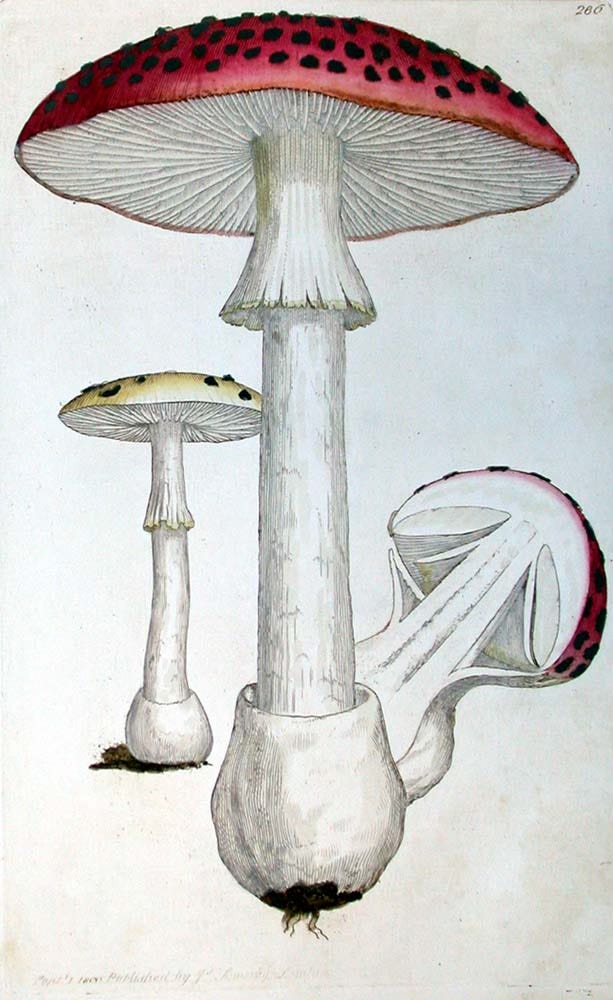
James Sowerby illustration (ca. 1800), in the American Museum of Natural History Library
“Believe me, I’ve heard. My mother was a poet; she loved the Latin rhythm of the word, long before she knew what it meant. It could have been worse. She could have named me ‘Chlamydia’ or ‘Dysentery.’”
“Or ‘Gonorrhea.’ Much worse!” he added.
She laughed, and left to get his breakfast.
While she was gone, he checked out the books. He could tell a lot about people—not just from the books they buy (assuming they even buy books), but from the books they keep. Amanita kept interesting, and unusual books… and in good editions. He also looked around the room, measuring its potential.
When she came back, he had a question for her. “How would you feel if I brought my laptop here to work while I enjoy your toast, et cetera?”
“You’re a writer?”
“Guilty as charged.”
“Okay. You can stay as long as you like… other than on Sunday, with the brunch crowd, I’ve got plenty of tables.”
There were only two tables, but he appreciated the offer. Glancing around the room, he speculated, “There are probably other writers living around here—but how would we ever know it? If there was a place, a place like this, we might get to know each other.”
She didn’t seem to take the hint, but that didn’t stop him. “You know, if you got an espresso machine, and a couple of thrift-store couches, and were willing to share your wi-fi, you would have everything you need to start a thriving coffee house.”
Warming to the idea, she asked, “A Kozy Korner Kitchen Kum Koffee Klatch?”
And that was how Sebastian brought the best of Brooklyn to the boonies.
Paid subscribers to these Substack pages get access to complete editions of two of my novellas. Noirvella is a modern story of revenge, told in the style of film noir. Unbelievable began as a rom-com that formed around a pompous guy who is conceited, misinformed, and undeservedly successful (it has since continued to grow as new stories about its anti-hero emerge). Both books are sold by Amazon, but paid subscribers get to read them for free. Also, substack pages (older than eight months) automatically slip behind a paywall—where only paid subscribers can read them. If you’re interested in reading any of them, you can subscribe (giving you free access to them), or buy them in book form should you prefer the feel of a physical book. Meanwhile, it is easy to become a paying subscriber (just like supporting your favorite NPR station). It’s entirely optional, and—even if you choose not to do so—you’ll still get my regular substack posts—and I’ll still be happy to have you as a reader.