Better Late Than Never

Mike O’Brien recently posted an essay (“Despair, Eternity, and Other Such Fluff”), in which he wrote:
I recently finished an anthology of works by Soren Kierkegaard which I had been picking away at for the last two or three years. That’s not so long by my standards. But it had been sitting on various bookshelves of mine since the early 2000s, being purchased for an undergrad Existentialism class, and now I feel the deep relief of finally doing my assigned homework, twenty-odd years late.
That certainly sounds familiar!
I have always been a voracious reader—just not of assigned readings. Perhaps it was due to an entirely unjustified feeling that I already knew everything I needed to know, or possibly I was convinced that I had better things to do with my time (better than homework, certainly), or—to invoke Occam’s Razor—I was just too damned lazy to be bothered. Most (but, alas, not all) of the time I was able to fake it.
I can’t remember how many times I’ve written papers about Hamlet—without reading a single couplet of it. Everyone knew all the pertinent details, so why bother reading the actual text?
Aside #1: I once had a literature professor who, each day, sat down behind his desk, opened his book bag, and took out his lecture notes. Those notes, I noticed, bore the familiar yellow and black covers of Cliff Notes. Granted, we were mere first-year students, enrolled in a required course, but I expected more from the man. Apparently, I was not the only slacker in the room.
But I digress.
The reason I’m writing, now, is because I have—like Mr. O’Brien—been gradually assembling and reading my way through a veritable library’s worth of the books I was supposed to have read way back then. Hamlet, to my surprise, turned out to have some pretty good stuff in it. Not that I would have appreciated it in the years when testosterone and ignorance were in charge of my education.
Books (even the ones I didn’t think I needed to read) are—more and more—what make me what I am. Humphrey Bogart, as Sam Spade in The Maltese Falcon, misquotes “the stuff that dreams are made of” instead of “on” (from The Tempest). For me, books are that stuff (hence the excerpt, below, from The Digressions of Dr Sanscravat: Gastronomical Ramblings & Other Diversions.
Aside #2: My cousin collects and maintains a large collection of model trains, the same kind he had as a child. I once asked him if he ever traded with other collectors. He responded, in profound, if mock, indignation, “I do not trade—I only acquire!”
The collector gene is strong in our family DNA.
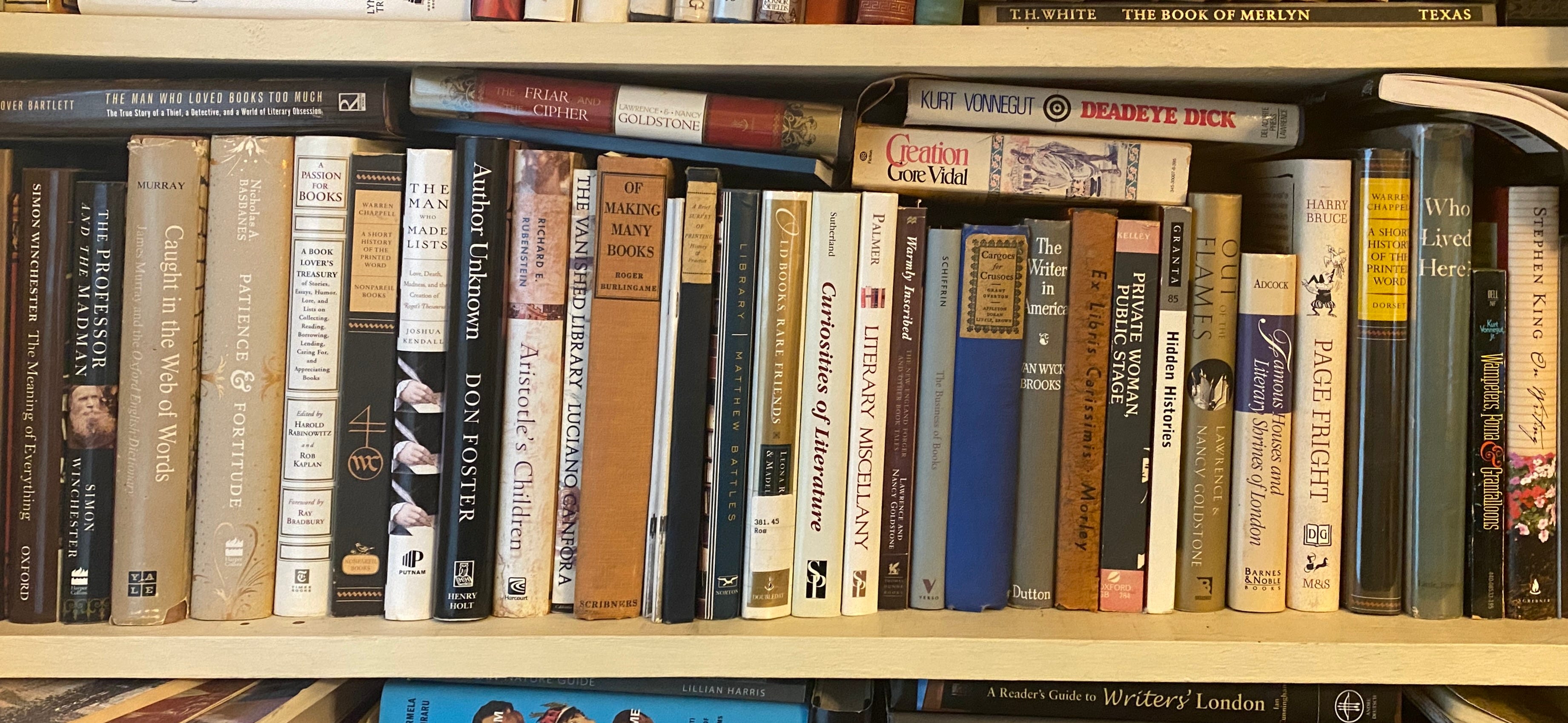
Bibliomania
(Noun) A progressive disease, one that, if you know its name, you have probably already contracted—and show little interest in finding a cure. A tip o’ the hat to Ambrose Bierce, currently MIA.
Bibliomania is not as rare as one might assume—but, as it first presents as a solitary vice, the percentage of infected individuals in the general population is difficult to measure. It’s only after the disease reaches its contagious stage (e.g., when patients lose all self-respect and exhibit onanistic symptoms in public) that we are even aware of its existence.
Book collectors are like gardeners—constantly tinkering, rearranging, thinning, dividing, and acquiring—always acquiring new interesting specimens that might, or might not, fit in with the rest of their “garden.” No garden, or book collection, is ever finished.
I own, and regularly read on, various tablets, but they haven’t reduced the bibliomaniacal fervor by even a smidgen of an iota.
I do, occasionally, remove a book from our shelves—usually because I’ve acquired a better edition. Alas, the better edition (hard cover) usually takes up more space than the worn-out paperback it replaces—so even discarding books results in a reduction of our available shelf-space.
Once, long ago, during a move, I grudgingly donated several boxes of books to a school library. Decades later, I still feel the pain of phantom book syndrome.
Paid subscribers to these substack pages get access to complete editions of two of my novellas. Noirvella is a modern story of revenge, told in the style of film noir. Unbelievable is a kind of rom-com that forms around a pompous guy who is conceited, misinformed, and undeservedly successful. Both books are sold by Amazon, but paid subscribers get to read them for free. Also, substack pages (older than eight months) automatically slip behind a paywall—where only paid subscribers can read them. If you’re interested in reading any of them, you can subscribe (giving you free access to them), or buy them in book form should you prefer the feel of a physical book. Meanwhile, it is easy to become a paying subscriber (just like supporting your favorite NPR station). It’s entirely optional, and—even if you choose not to do so—you’ll still get my regular substack posts—and I’ll still be happy to have you as a reader.