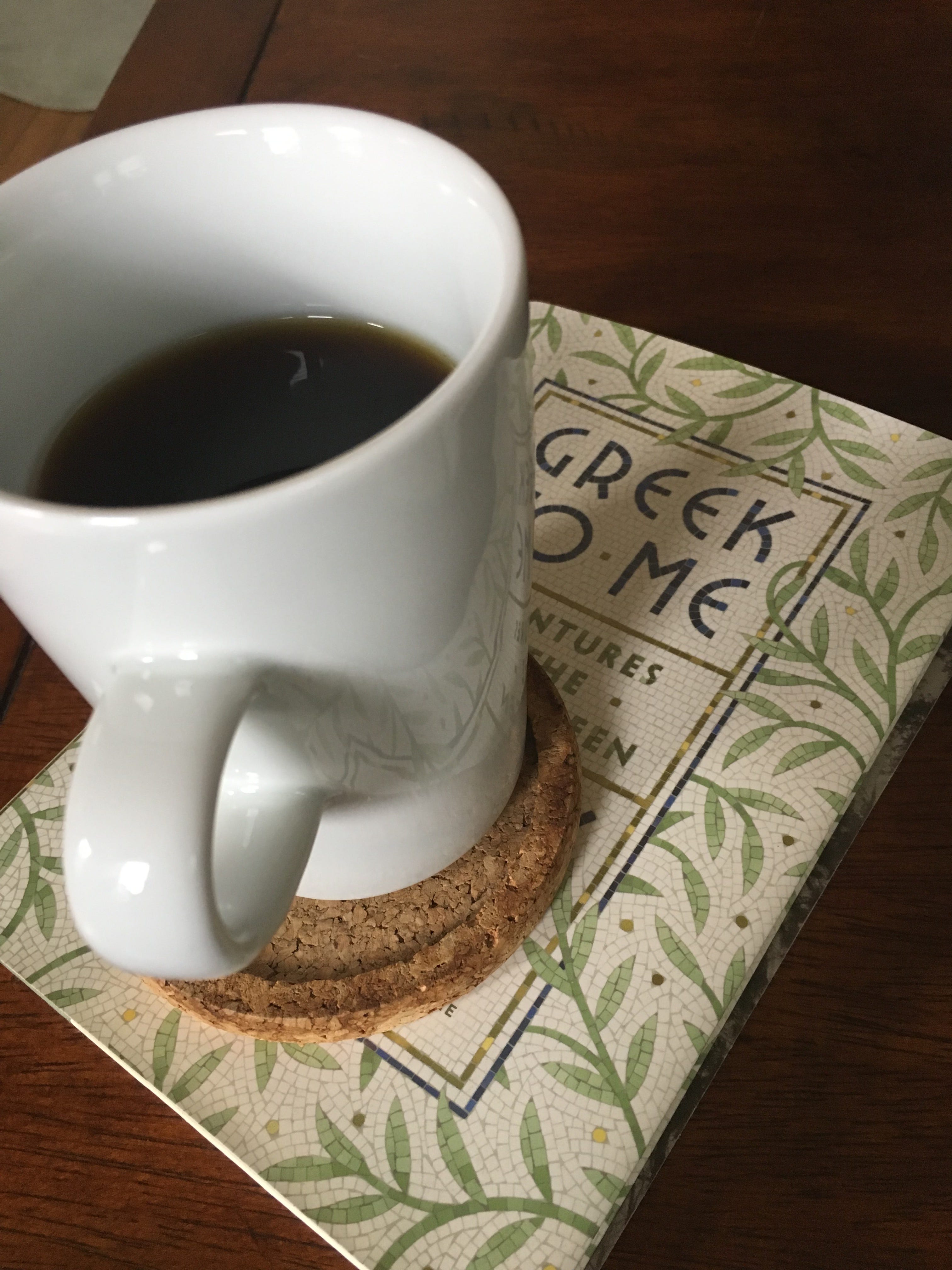
Java Jump-start
My morning routine is—”routine” says it all, doesn’t it?—the same each day: emerge from the half-awake no-man’s land between pure unconsciousness and wakefulness, and, with any luck, pre-loaded with an idea for a story or essay percolating in my head, then stumble down the stairs to the kitchen. Make the coffee, or—in a pinch—pop a cup of left-over coffee into the microwave.
Of course, I appreciate good, fresh-ground, and brewed coffee, but—first things first—there must be caffeine.
At one time, I imagined an improvement on the old-fashioned alarm clock: a pot that automatically ground and brewed Coffea arabica with spring water in a perfect ratio—but delivered sans cup or mug. The essential fluid would flow through fine tubing, directly into a permanent IV portal. Twenty minutes before it’s time to wake up, the caffeine would begin flowing through my veins, and my eyes would pop open, already sufficiently-alert to deal with the new day—and the dreaded blank page.
The connection between coffee and writing is well-established. Voltaire was a regular at Cafe Procope, the world’s first coffeehouse. One cannot say for sure, but I suspect that he (and, no doubt, his colleagues in belles-lettres) were busy with their laptops, in their version of a Starbucks. The following passage has been extracted from How to Write a Great Book.
From “Coffee, Tea or Perhaps Something More Stimulating”
According to Annie Dillard, Jack London maintained a heavy writing schedule. He “...claimed to write twenty hours a day ...[when] he had a book of his own under way, he set his alarm to wake him after four hours’ sleep. Often he slept through the alarm, so, by his own account, he rigged it to drop a weight on his head.”
Chemistry naturally (or unnaturally) provides less-mechanical methods for staying awake at one’s desk.
Some writers have to get liquored- or coffeed- or amphetamined-up to get started, while other just can’t stop the flow of words. Charles Bukowski had a ten-page quota, but could only achieve it by consuming a six-pack of beer and a pint flask of whiskey. Steinbeck had a less-rigid quota, but when he was too drunk to meet it, or too hung-over, he’d try to make it up when sober (the arrangement seems to have been pretty flexible).
No doubt about it, hooch stimulates the flow of verbiage. The difficulty (as anyone who has ever been cornered by a loquacious drunk knows) is that so few of those hi-octane words make any sense. For writers, depressants like alcohol are not as effective for long-term productivity as stimulants. For most of the last four centuries, coffee and tea have been the scribbler’s drugs of preference.
As Tallyrand once wrote—his twitching pen, presumably, abuzz with caffeine: “As soon as coffee is in your stomach, there is a general commotion. Ideas begin to move... similes arise, the paper is covered. Coffee is your ally, and writing ceases to be a struggle.”
Alfréd Rényi said (not of writers, though the statement is just as true about writers), “a mathematician is a machine for turning coffee into theorems.” Rényi’s friend, Paul Erdös, was the most prolific writer of mathematical papers in history—due, in part, to his massive coffee consumption (and, eventually, of amphetamines). He once bet a friend that he could lay off the stronger stimulants for a month; he succeeded, but grumbled, “Before, when I looked at a piece of blank paper my mind was filled with ideas. Now all I see is a blank piece of paper.” Needless to say, he immediately took up “speed writing” again.
Another bet challenged Alexandre Dumas, père, to write the first volume of Le Chevalier de Moulin Rouge in three days. Sixty-six hours later, he handed over the manuscript: thirty-four thousand coffee-stained words. That’s over 500 words per hour, every hour, which is remarkable, considering that—with all that coffee—some of those hours must have been spent à la pissoir.
Proust, who also managed to write a little, once knocked back sixteen cups of espresso at one sitting. Balzac, a speed freak in more ways than one, probably consumed fifty thousand cups of his house blend of beans from Martinique, Réunion, and Yemen. Between writing and editing, he spent two-thirds of every waking hour at work. In his essay, “The Pleasures and Pains of Coffee,” he confessed that he sometimes ate coffee grounds when thirty-odd cups didn’t provide the required buzz. He also described coffee’s effect on the writing process (I don’t even have to wake up to smell that coffee):
... sparks shoot all the way up to the brain. From that moment on, everything becomes agitated. Ideas quick-march into motion like battalions of a grand army to its legendary fighting ground, and the battle rages. Memories charge in, bright flags on high; the cavalry of metaphor deploys with a magnificent gallop; the artillery of logic rushes up with clattering wagons and cartridges; on imagination’s orders, sharpshooters sight and fire; forms and shapes and characters rear up; the paper is spread with ink - for the nightly labor begins and ends with torrents of this black water, as a battle opens and concludes with black powder.
The habitually late-rising Gertrude Stein believed that coffee would make her nervous, but had one cup every morning on the recommendation of her doctor. For some reason, that excuse reminds me of Mark Twain’s routine of having two hot scotches every night, just before bedtime. He claimed he did so to prevent toothaches. He went on to say, “I’ve never had the toothache.” Then added, “I don’t ever intend to have the toothache.”
Dave Barry, who occasionally exchanges his bathrobe for out-door clothes for emergency prophylaxes, said, “It is inhumane, in my opinion, to force people who have a genuine medical need for coffee to wait in line behind people who apparently view it as some kind of recreational activity.” Albert Camus made much the same point, albeit more existentially: “Should I kill myself, or have a cup of coffee?”
Paid subscribers to these substack pages get access to complete editions of two of my novellas. Noirvella is a modern story of revenge, told in the style of film noir. Unbelievable is a kind of rom-com that forms around a pompous guy who is conceited, misinformed, and undeservedly successful. Both books are sold by Amazon, but paid subscribers get to read them for free. Also, substack pages (older than eight months) automatically slip behind a paywall—where only paid subscribers can read them. If you’re interested in reading any of them, you can subscribe (giving you free access to them), or buy them in book form should you prefer the feel of a physical book. Meanwhile, it is easy to become a paying subscriber (just like supporting your favorite NPR station). It’s entirely optional, and—even if you choose not to do so—you’ll still get my regular substack posts—and I’ll still be happy to have you as a reader.


Just reading this over my morning coffee, ☕️, ready to jump start the day. Thank you, Gary!