Loosing Literary Threads

“On the eighteenth of April, in Seventy-Five:
Hardly a man is now alive
Who remembers that famous day and year.” H. W. Longfellow
On that date, in England, Samuel Johnson and James Boswell were about to have their dinner. Doctor Sam was very particular about his victuals. He wrote: "A man seldom thinks with more earnestness of anything than he does of his dinner; and if he cannot get that well dressed, he should be suspected of inaccuracy in other things."
He couldn’t understand why anyone would feel otherwise: "Some people have a foolish way of not minding, or of pretending not to mind, what they eat. For my part, I mind my belly very studiously and very carefully; for I look upon it that he who does not mind his belly will hardly mind anything else."
Boswell also had serious appetites, but they were not as refined as Johnson’s. It’s no accident that there is a book entitled Boswell’s Clap. His journals are filled with complaints about recurrent flare-ups of STDs.
But I digress…
On the evening in question, the great biographer and his biographee were entertaining another writer: Edward Gibbon. Gibbon was taking a break from writing his multivolume opus, The History of the Decline and Fall of the Roman Empire. His hosts—who were, themselves, prolific penmen—are reported to have complained, “Scribble, scribble, scribble… eh, Mr. Gibbon?”
I mention this dinner because of a curious coincidence: At the same time, on the opposite shore of the Atlantic Ocean. two lanterns were being hung on the steeple of The Old North Church. On the other side of the Charles River, Paul Revere (and William Dawes) were prepared to warn Samuel Adams, John Hancock—and other revolutionaries—about the approach of British regulars. Popular versions of this event have Revere shouting, “The British are coming! The British are coming!” That’s not right; everyone along the way still thought of themselves as “British.” They wouldn’t start thinking of themselves as “American” for another year.
Aside: The Gibbon/Johnson/Boswell dinner—occurring while Gibbon was documenting the fall of the Roman Empire—coincided with the first unravellings of the British Empire’s fall.
Early the next morning, Ralph Waldo Emerson’s father and grandfather looked from their back door toward the stream at the bottom of their property. They watched a ragtag bunch of their neighbors exchange musket fire with a troop of red-coated soldiers. A generation later, Emerson sat in the same house, writing his poem, “Concord Hymn.”
By the rude bridge that arched the flood,
Their flag to April’s breeze unfurled,
Here once the embattled farmers stood,
And fired the shot heard round the world.
Emerson later rented the house—called The Manse—to the newly-wed Nathaniel Hawthorne. Hawthorne would later write Mosses from an Old Manse based on his time there. Before moving there, he had rented Bronson Alcott’s house, across the street from Emerson’s (& where Louisa May Alcott had eked out a living writing gothic stories for magazines). Hawthorne, who was descended from Judge Hathorne—who had convicted several witches in Salem—wrote his own gothic stories there. “Young Goodman Brown,” The Scarlet Letter, and The House of the Seven Gables address the darker parts of his ancestry.
In a happier moment, he and his wife scratched their initials on the glass of their bedroom window with the diamond of her engagement ring. That window looked down on the vegetable garden that Thoreau planted for them as a wedding present.
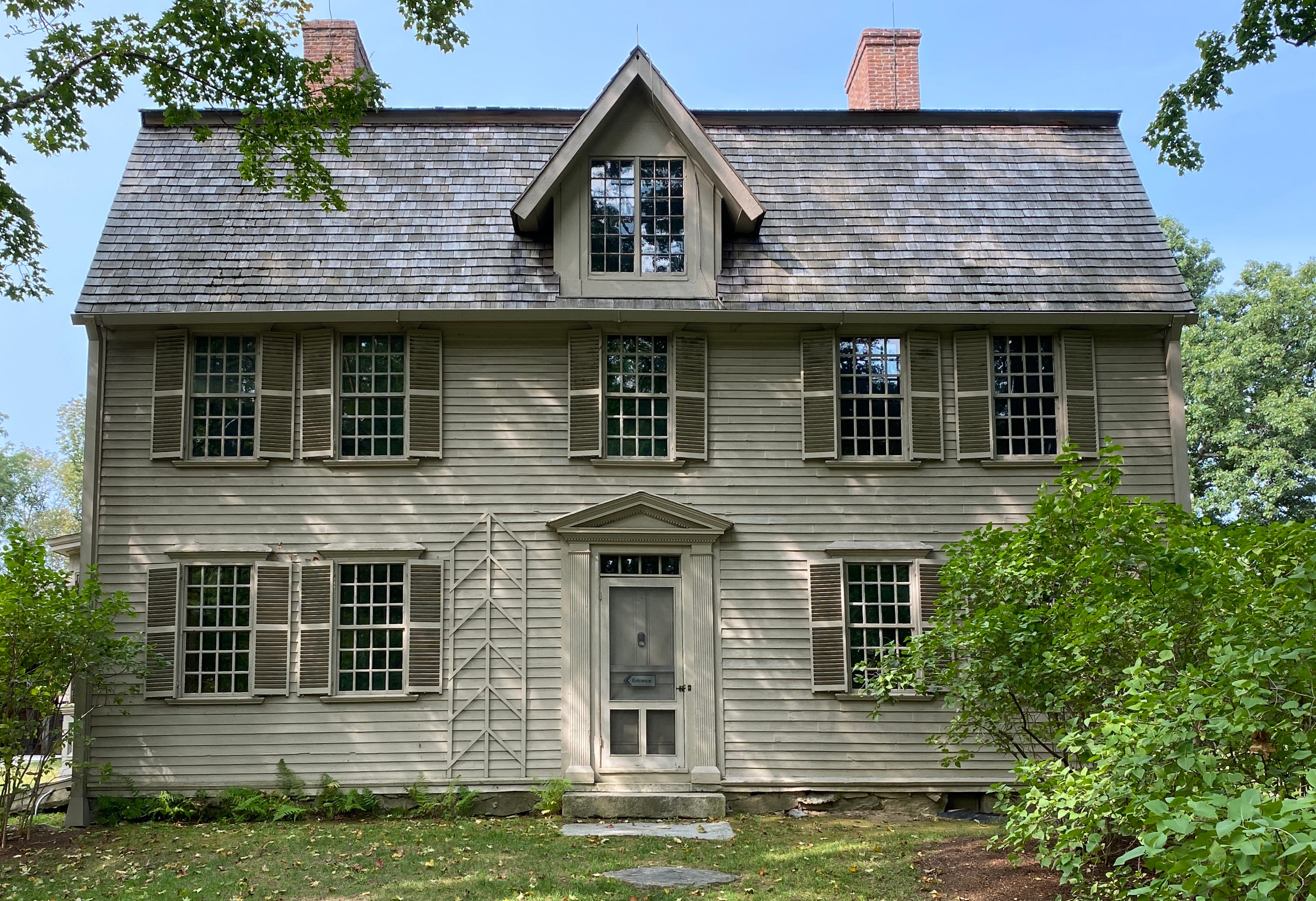
The Manse, Concord, MA
It tickles me that a small event connecting three literary figures in England happened at the same time as a long skein of other connected literary figures was unrolling across the ocean.
Paid subscribers to these Substack pages get access to complete editions of two of my novellas. Noirvella is a modern story of revenge, told in the style of film noir. Unbelievable is a kind of rom-com that forms around a pompous guy who is conceited, misinformed, and undeservedly successful. Both books are sold by Amazon, but paid subscribers can read them for free. Also, Substack pages (older than eight months) automatically slip behind a paywall—where only paid subscribers can read them. If you’re interested in reading any of them, you can subscribe (giving you free access to them) or buy them in book form, should you prefer the feel of a physical book. Meanwhile, it is easy to become a paying subscriber (just like supporting your favorite NPR station). It’s entirely optional, and—even if you choose not to do so—you’ll still get my regular Substack posts—and I’ll still be happy to have you as a reader.
Thanx, Nancy (& fascinating, your connection to Hangin'-judge Hathorne). I believe I saw his grave in Salem. Writing the piece felt like Six-Degrees-of-Separation.
I don't have any really repugnant ancestors (unless I go WAY back)... 'though it pains me to know that many of my (southern) kin owned slaves.
Hard to know how the words were actually pronounced in the past (or it was a self-conscious use of assonance)...
Sheer brilliance, Gary. I love all the connections. I too am a descendant, reluctantly, of Judge Hathorne and the Hathornes who came to Maine kept the spelling. We always thought of Nathaniel as a bit hoity-toity for changing it but I get his reasoning. Still, Maine was far enough from Salem to avoid the taint of the judge's hypocrisy. (He does remind me of an another Maine resident, albeit summer only, Chief Justice Roberts, who is even as I write being assaulted by an army of protesting kayakers swarming in the waters around his island home.)
All that being said, I have to say I adore the coincidences and I intend to use the Sam'l Johnson quote, attributing it to you, at the earliest opportunity.
Did you ever wonder about the rhyming of flood with stood in Emerson's poem?