Re: Quest

Dominic Scalise recently posted a substack page (Guys, I Think We Like Typewriters), in which he describes the obsession many writers have for their machines. I admit to being fascinated by them—I have an ancient Royal typewriter that I keep, just for its looks. I wouldn’t think of writing on it (for one thing, some of its parts are missing and are not likely replaceable); Besides, I’m a terrible typist (only word processing software made it possible for me to produce a LOT of books).
Before I was writer, I had worked as an illustrator. When I saw the first issue of Quest Magazine, I was impressed by its graphic quality. One illustration, by Joe Ciardello, was particularly beautiful. It was for a story by T. Coraghessan Boyle—a name I’d never seen before (I later learned that the writer was my high school buddy, Tommy Boyle). The look of Quest made me want to get my work published there. Since I was beginning a career in illustration, I sent sample cards of my work to the art directors of hundreds of magazines, Quest among them.
One day, a call came in from Quest’s art director, Joyce Weston, saying she had an assignment for me. I was to illustrate an article (“The Pen is Mightier…”) written by Edmund Morris, who had just won the Pulitzer Prize for Biography or Autobiography and the National Book Award for biography for the first volume of his trilogy about Teddy Roosevelt. His thesis, in the article, was that writing with a pen was more conducive to the creative process than typewriters.
Ironically, this was 1980—just as word processors were poised to replace typewriters.
I did a fanciful, full-color drawing of a knight on horseback, holding a giant fountain pen instead of a lance. The magazine came out—with my drawing—so I’d achieved my goal. Then I got a phone call from Edmond Morris, himself. He loved the drawing and wanted to buy it! We agreed on a price (a little money and a signed copy of his book). He schlepped to my Upper West Side apartment, and also gave me a signed copy of his wife, Sylvia Jukes’s book, Edith Kermit Roosevelt: Portrait of a First Lady—both of which, of course, I still have.
Years later, Morris contacted me again. He asked for my permission to reuse that drawing in a new book he was about to publish. I was impressed—and delighted—that he would consider my feelings about a drawing that he owned. It was an almost knightly display of courtesy, something that is increasingly rare in this post-medieval world.
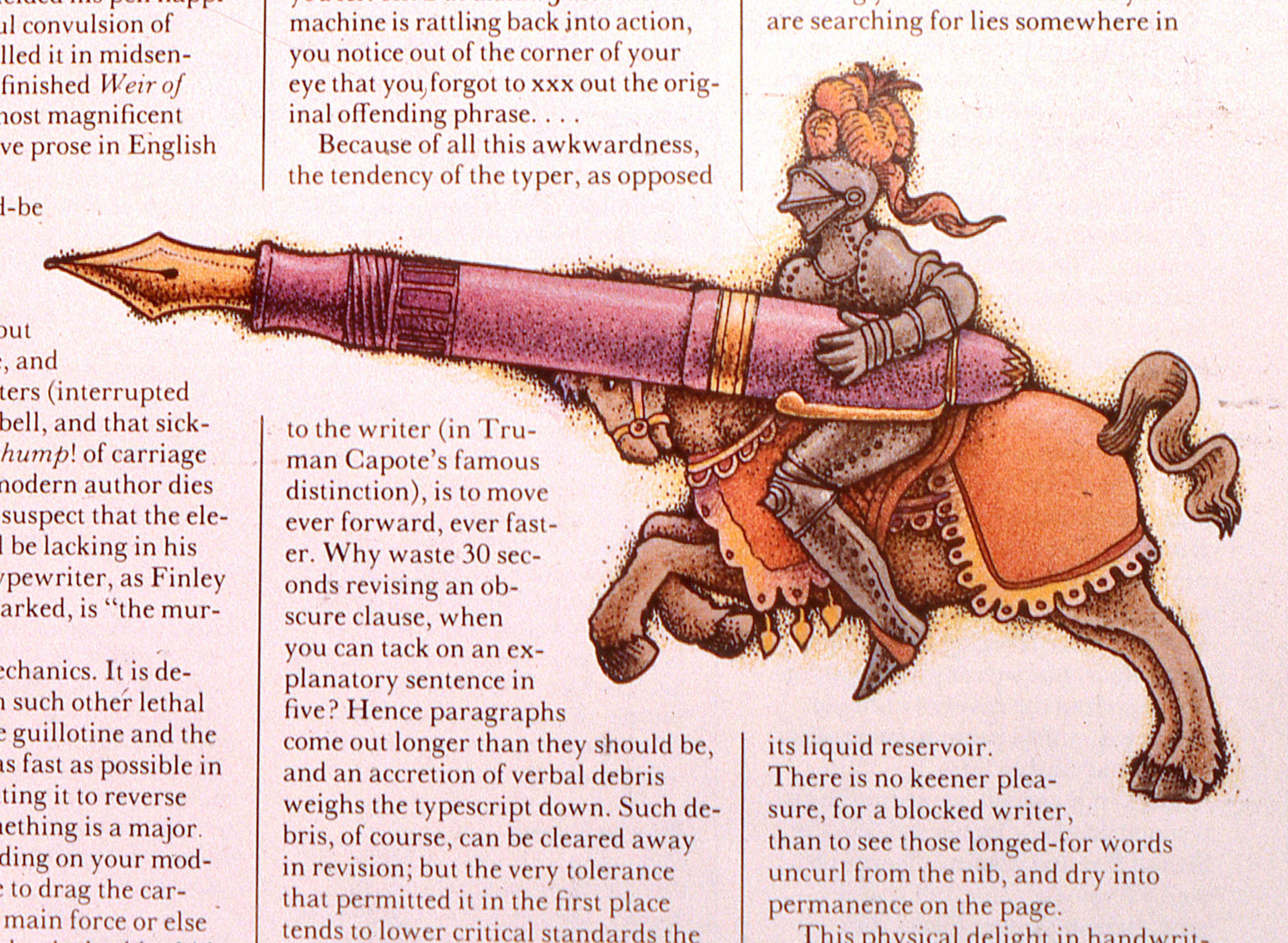
In 2012, my literary knight returned to joust once more in This Living Hand and Other Essays.
Paid subscribers to these Substack pages get access to complete editions of two of my novellas. Noirvella is a modern story of revenge, told in the style of film noir. Unbelievable began as a rom-com that formed around a pompous guy who is conceited, misinformed, and undeservedly successful (it has since continued to grow as new stories about its anti-hero emerge). Both books are sold by Amazon, but paid subscribers get to read them for free. Also, substack pages (older than eight months) automatically slip behind a paywall—where only paid subscribers can read them. If you’re interested in reading any of them, you can subscribe (giving you free access to them), or buy them in book form should you prefer the feel of a physical book. Meanwhile, it is easy to become a paying subscriber (just like supporting your favorite NPR or PBS station). It’s entirely optional, and—even if you choose not to pay—you’ll still get my regular substack posts—I’m always happy to have free subscribers as readers.
Love the illustration.
Typists and typewriters are the subject of this exhibit at Harvard's Houghton Library.
https://library.harvard.edu/exhibits/thanks-typing
Enjoy, Jeri
Were you just reading "The Greatest Sentence Ever Written"? I read a passage about that printing, just two days ago!