Some BookWOIMs

“Despite all her privileges, despite her strenuous socializing, she remained an isolate and a misfit, which is to say, a born writer.” Jonathan Franzen, on Edith Wharton
A while back, I wrote a tongue-in-cheek how-to book (How to Write a Great Book) that spelled out—in ludicrous detail—exactly how the great writers did it. In a chapter on some of the ways writers financed their writing addictions, I wrote a little about Wharton (see below). I never said that she did her writing at her desk; I know that she didn’t.
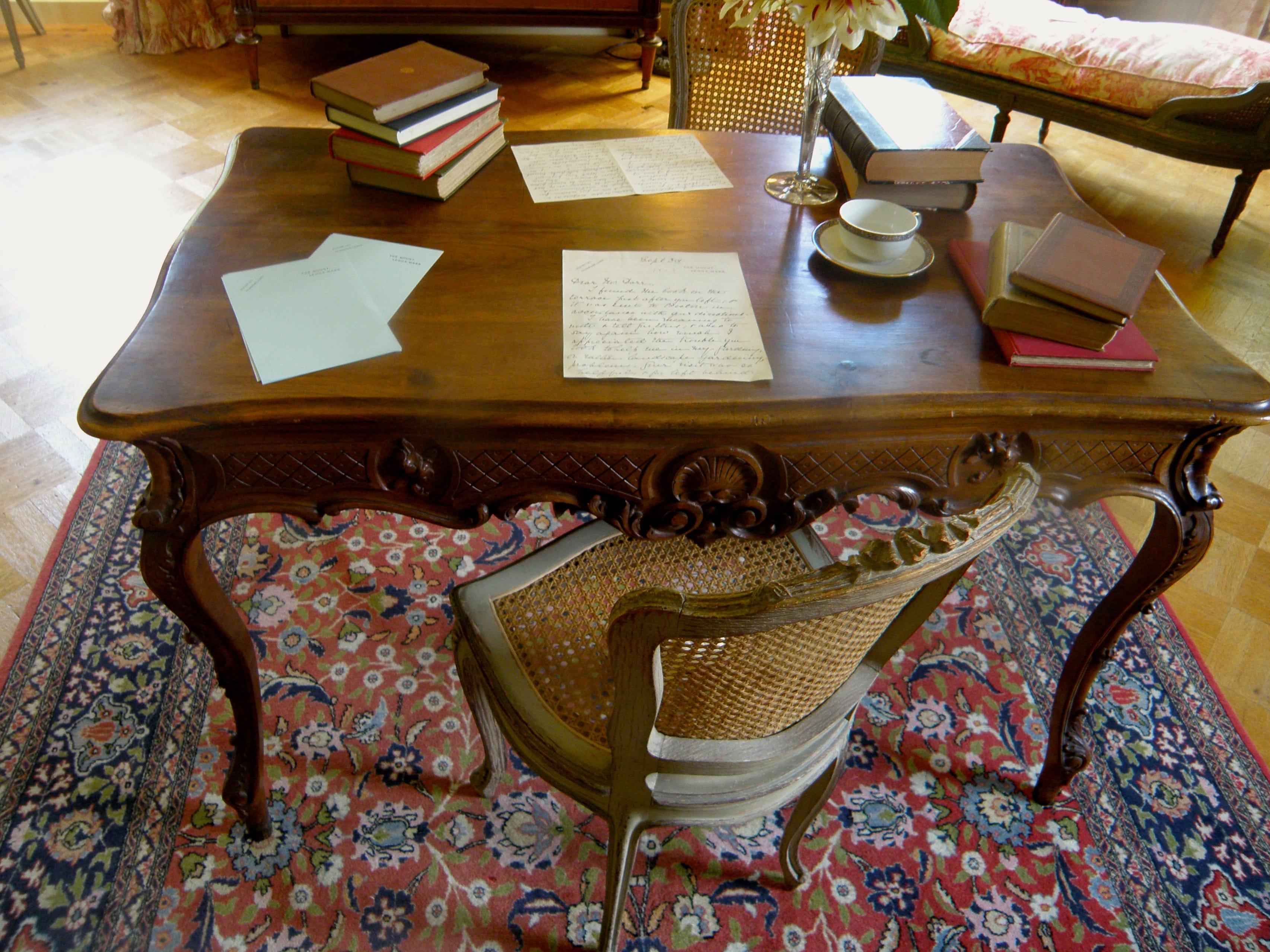
Wharton’s desk at The Mount
She wrote in bed, cushioned by as many pillows as a woman of privilege could afford, then casually flipped the finished pages onto the floor.
Like Twain, she did not do her own typing—they had secretaries for that.
Aside: it’s curious that they both had success in writing about “the gilded age,” from the vantage point of wealth (‘though only Wharton had been born to it).
First excerpt from my book:
Not far from Melville’s modest home, Edith Wharton’s luxurious estate—The Mount—also provided a literarily productive view. Wharton wrote in bed, gazing out the window at this idyllic scene in The House of Mirth:
The windows stood open to the sparkling freshness of the September morning, and between the yellow boughs she caught a perspective of hedges and parterres leading by degrees of lessening formality to the free undulations of the park.
Only a few miles separate Wharton’s Great Barrington and Melville’s Pittsfield, but they are half a century and a world apart.
Elsewhere, in my book, I described “writers of independent means” as despicable WOIMs. That term might have been applied to Wharton—but, while she didn’t need the money her books earned, she was generous with it. So she was not a despicable WOIM... as this second passage from my book explains:
Edith Wharton was one of the few writers who started making good money from her writing at an early age. Wharton was able to buy a fancy touring car with the royalties from just one of her books. It was a 1904 Pope-Hartford, a one-cylinder, ten-horse-powered beauty, trimmed with brass and equipped with headlights as a standard feature (unusual at the time). Her day trips in the car provided local color that she used in Ethan Frome and Summer.
Wharton named her car after George Sand’s lover, Alfred de Musset. Henry James, however, called it “She, the Great She” or “The Vehicle of Passion.” He once wrote to tell her that his book, The Wings of the Dove, was so profitable that he could buy a small, rusty wheelbarrow. He modestly explained that ‘‘It needs a coat of paint. With the proceeds of my next novel I shall have it painted.’’
Wharton and James were not lovers (they met when he was 63—a celibate gay man—and she a 41-year-old survivor of a couple of disastrous heterosexual relationships), but there is more than a suggestion of sugar-mommy in their association. They shared a publisher—Scribner’s—yet James was surprised when, late in his life, he received an unusually large advance for one of his books. What he didn’t know was that Wharton had secretly arranged to have some of her royalties diverted to cover the publisher’s cost of the advance.
Paid subscribers to these Substack pages get access to complete editions of two of my novellas. Noirvella is a modern story of revenge, told in the style of film noir. Unbelievable is a kind of rom-com that forms around a pompous guy who is conceited, misinformed, and undeservedly successful. Both books are sold by Amazon, but paid subscribers can read them for free. Also, Substack pages (older than eight months) automatically slip behind a paywall—where only paid subscribers can read them. If you’re interested in reading any of them, you can subscribe (giving you free access to them) or buy them in book form, should you prefer the feel of a physical book. Meanwhile, it is easy to become a paying subscriber (just like supporting your favorite NPR station). It’s entirely optional, and—even if you choose not to do so—you’ll still get my regular Substack posts—and I’ll still be happy to have you as a reader.
That's my job... literary gossip-monger (mostly about writers who are too dead to take me to court).
Many years ago, I sat at her desk at the Mount during filming of a PBS movie. They needed to have some manuscript pages on the desk and I had to sit there and write caligraphically. (If that is a word) While cameras, crew, stars waited impatiently. Pretty stressful.