Something Very Different...

…from the things I usually post. It’s complete fiction, of course, but it addresses a couple of issues that don’t appear to have troubled Mary Wollstonecraft Shelley.
This longish story was written a few years ago—but, since that time, we have all learned that Elon Musk has a company called “Neuralink” that is exploring the use of brain chips to do something like what I imagined in the story.
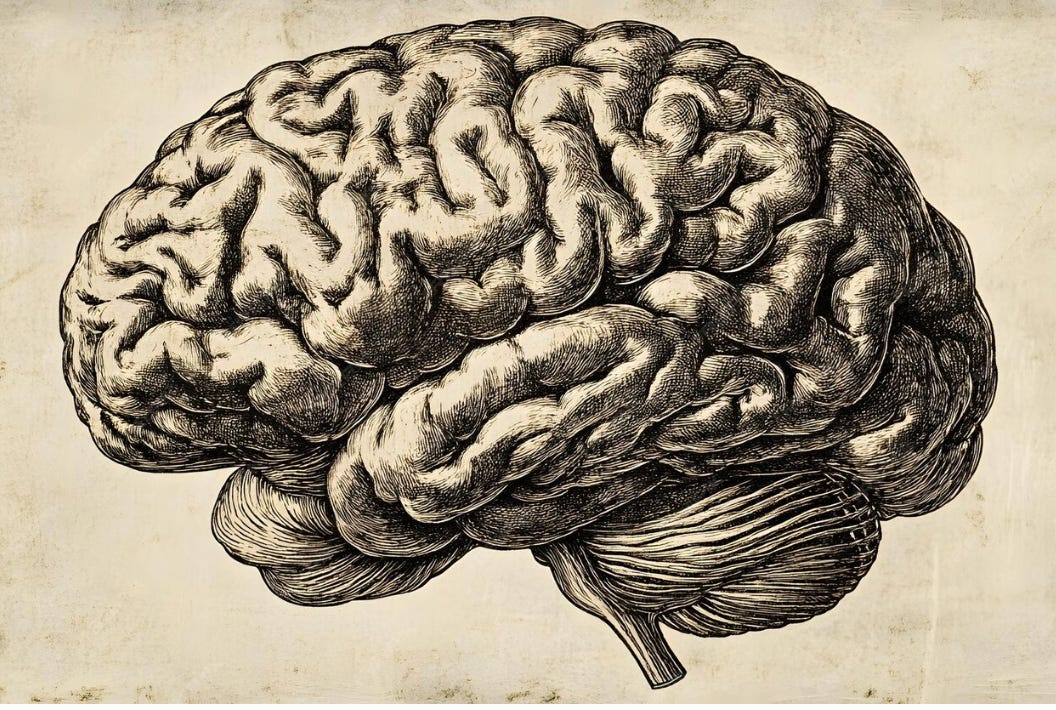
It’s an example of Life (or, at least, Commerce) imitating Art, I suppose…
The seemingly old-fashioned image of a human brain was generated by AI software… and without any assistance from me. It is, as far as I can tell, copyright-free.
The story appeared in Beer Taste & Other Disorders.
Dead to Me: A Post-Modern Prometheus
Early on the morning of January eighteenth, 1803,
in London’s Newgate prison,
a murderer—George Foster—was hung by the neck until dead.
It was only the first of the indignities he was to experience that day.
Entries from the journal of Dr. B. F. Stein, MD PhD
18 April 2021. For some time, I’d been feeling slightly uneasy, without knowing why. Today, at my annual physical, Doctor Johnson commented on the elevated level of my white blood cell count. A large number of white blood cells are not, in themselves, a danger—but they may be indicators of some other problem. He suggested that I be screened for cancer. Naturally, I hope that it was more caused by some kind of infection—rather than leukemia—but I prudently agreed to a scan.
21 April 2021. Not one of my better days. I received a text from my doctor’s office, urging me to call back as soon as possible. In my practice, as a forensic coroner, I have never had to make the sort of uncomfortable calls other medical colleagues sometimes have to make—but I know, all too well, what they portend. They’re never good news. When I responded, Doctor Johnson suggested that I come into the office “to talk.”
23 April 2021. “The talk” was much as I had feared. His diagnosis was incurable leukemia. With proper management of treatments and frequent transfusions, I might have three or four years before the inevitable. I need to begin—as the euphemism goes—“getting my things in order.”
25 April 2021. There are several stages of grief that people pass through after becoming aware of their terminal illnesses. I might be stuck in the first stage, the one called “denial.” I say this because—while I have always been a student of medical history, for reasons that must seem obvious in retrospect—I have lately been intrigued by certain Italian medical scientists. Specifically, the late eighteenth-century experimenter, Luigi Galvani, and—more to the point—his nephew, Giovanni Aldini.
Aldini had been fascinated by what we now call “the galvanic response” when tissues react to stimulation by an electric current. In the early nineteenth century, a time when grave robbers supplied most of the cadavers needed by medical science, the bodies of condemned criminals were available, legally. Aldini acquired the fresh corpse of one such individual, George Foster.
Before a mixed audience of scholars and idle onlookers (who possessed no credentials beyond their curiosity about the grotesque), he applied an electric current to various parts of the late Mr. Foster. One account of the experiment (from The Newgate Calendar) was especially gruesome:
“On the first application of the process to the face, the jaws of the deceased criminal began to quiver, and the adjoining muscles were horribly contorted, and one eye was actually opened. In the subsequent part of the process the right hand was raised and clenched, and the legs and thighs were set in motion. ...Some of the uninformed bystanders thought that the wretched man was on the eve of being restored to life.”
It was, indeed, a wretched thing to do to Mr. Foster, who—as you know—had already been through a pretty trying day. But those “uninformed bystanders” were not the only ones to jump to the same conclusion. Mary Shelly clearly had the same idea in mind when she wrote, “Perhaps a corpse would be re-animated; galvanism had given token of such things: perhaps the component parts of a creature might be manufactured, brought together, and endued with vital warmth.”
It occurs to me that those misguided nineteenth-century minds might have jumped to the wrong conclusion, but not entirely. Their error was not a misfunction of logic; but was grounded in an ignorance of technologies that were as-yet-undiscovered. Today we have been able to revive certain corpses (people who have been briefly lifeless). Especially drowning victims whose bodies had been chilled by icy waters, for whom the processes of decomposition had not had the opportunity to corrupt the flesh.
26 April 2021. I didn’t realize it, at first, but my fascination with the two Italian scientists’ work was a kind of shadow puppet. I could make out the shape of their ideas, but the hidden movements that generated those shadows were my unconscious desires to find a way to escape—or, rather, recover from—my own death.
Clearly, my own body is not worth saving. Cancer will just continue its efforts to destroy its host. Besides, I’ve never been impressed by my physical form. I am short, somewhat portly, with stringy hair that has never adequately disguised my over-sized ears. My body has never been me. I will not miss my body; it’s plagued by irritating aches, pains, and inconvenient urges.
What troubles me about my impending demise is the annihilation of the self. What makes me me is the contents of my mind. If I am to survive death, then I must preserve my mind. Mary Shelley’s idea of transplanting a brain—which has become a trope for generations of film directors, from James Whale (1931) to Mel Brooks (1974)—is clearly impractical.
How could I manage to transplant my own brain?
Besides... it’s not the brain itself that needs preserving; it’s my mind. My familiarity with computer science suggested a solution. Computer hardware and the data stored on it are independent. The data can be moved from one device to another with no loss of integrity—what we might call its vitality. What I need to do is transfer my “data” from its failing hardware to another device before it is irrevocably lost. I need to explore the possibilities available to me.
28 April 2021. Eureka! In a recent article in a tech journal, I discovered that a group of scientists has successfully conducted experiments in which they downloaded and uploaded packets of information into a living brain by stimulating certain regions with tiny electric pulses. So far, they have utilized small electrodes placed in the living tissue, but they are convinced that the same effect can be duplicated with small transmitters on the scalp.
This suggests that I could conceivably upload all of the contents of my mind into an appropriately constructed machine. I could live on as a mental presence inside a kind of robot.
29 April 2021. Another day and cooler thoughts replace yesterday’s enthusiasm. If I am to continue a sapient existence in the physical world, I’ll need a physical body to interface with that world. A physical body with all the conventional sensory apparati. My mind is the only thing I need to preserve. The only reason for even having a body is to provide for the brain’s glucose and oxygen needs—and obtain sensory data from the outside world. Beyond those functions, a body is just an inconvenience. I might not like my current body, but I must admit that it does effectively collect all sorts of data from the external world. Some of that data might not be to my liking, but I can always discard the parts that don’t interest me—which means that I must first collect it. I don’t think any kind of robot will provide the level of sensitivity to external stimuli that can provide my desired level of intellectual flexibility.
Robots are out.
30 April 2021. I don’t know why I didn’t make the connection sooner! Perhaps my subconscious mind had been working out the problem before I was even aware of it. Aldini was speaking, across the centuries, directly to me. As a brother scientist, I could re-enact his experiment—using technologies of such sophistication that he could never have imagined possible. At the same time, I might save my own life.
1 May 2021. Today, I began assembling the rudiments of my great experiment. The first step was writing the letter which I include, below:
Warden Emmett Janus
Sing Sing Correctional Facility
Ossining, NY
Mr. Janus.
I am a forensic pathologist, employed by the criminal justice department of the City of New York.
It might seem that you and I have little in common, but we both serve in—admittedly different—parts of the justice system. While you employ your managerial talents in the housing of convicted criminals, I employ scientific methods to ensure that the right people become those convicted criminals. One might say that we are two sides of the same legal coin.
I’m writing to you, today, because it occurs to me that you have a resource that might aid me (and my forensic colleagues) in our work.
It is sometimes crucial to be able to establish, with pinpoint accuracy, the time of death of a possible crime victim. As you might suppose, a number of environmental factors make such calculations difficult.
If, on the other hand, we knew the exact time of death, and were able to study the precise sequence of stages of decomposition, we could assemble a database from which we could—in reverse order—determine the exact time of death when it is not known.
You are in the unique position of knowing, precisely—and in advance—the moment when a convicted criminal is to be executed. Do you see how valuable such information could be in my work?
While I’m sure that there are legal and technical hurdles for both of us to overcome, allow me to provide a rough outline of the parts of my plan that involves both of us:
1. We would need to get one or more volunteers from the population of condemned criminals. Is “death row” still a term in use? Forgive me if my knowledge of “your side of the business” is out of date.
2. Together, we can determine which candidate, or candidates, would be most likely to provide the kind of data I hope to obtain from the research. I would conduct interviews with potential test subjects, to determine their suitability for the study.
3. I would need to be present, at the execution, prepared with whatever I need to preserve the body in such a way that no data is lost in transit to my laboratory.
This is, obviously, only the first part of a conversation I hope we can continue to our mutual benefit.
Yours,
B. F. Stein, MD PhD
Office of Chief Medical Examiner of the City of New York
520 First Avenue
New York, NY 10016
2 May 2021. While I wait for a response from Warden Janus, I have begun preparing for the experiment. I started collecting pints of my blood and arranged for its safe storage. In a little less than eighteen months, I will have enough to completely replace the blood of my subject’s body. This is essential, as I need to be certain that no trace of two active ingredients (in the lethal injection) remains in the body. One arrests breathing (by paralyzing the respiratory muscles), and the other one stops the heart. If I have any hope of reviving my body donor, these compounds must first be removed.
I have also collected a small amount of my cerebrospinal fluid. I’m not sure that it will aid in the transfer of my mind’s data, but I don’t want to skip any opportunity that might be efficacious.
3 May 2021. I have begun work on the questionnaire to be used for screening potential donors:
Expected date of execution:
Race/ethnicity:
Age:
Height:
Weight:
Blood type [not critical, since my O-negative blood makes me a universal donor]:
Health history [no point in trading one damaged body for another]:
Drug, tobacco, and alcohol use [same as above]:
Criminal history [extensive media coverage might make the donor too recognizable]:
A current photo.
Needless to say, I would not share all of my reasons for this data with the warden and any other authorities that might be involved [comments in brackets will, obviously, not be part of the questionnaires].
The first item is crucial—for me. I need time to prepare all the details that I am not explaining, and I’d prefer to conduct the experiment well before my personal expiration date. A date about two years from now would be ideal.
The last item is pure vanity. While I’m used to inhabiting a body that is not especially god-like, I have a hard time imagining my mind encased in the body of a disgusting toad-monster (having lived with such a body, I have no desire to do so again). I’d like to reserve a few peremptory strikes for the ugliest candidates. My current body may be less than perfect, but I see no good reason—given the choice—to trade down.
12 June 2021. I was surprised at how quickly the experiment’s proposal was approved by the authorities. No doubt, my status in the Medical Examiner’s Office had a lot to do with its acceptance. My questionnaire—along with an introductory letter explaining that participation in the experiment was a way to give something back to the society they had offended—was distributed to the potential donors. It’s always nice to appeal to one’s better nature. Assuming there is one. I am also prepared to offer certain other incentives, if needed.
Unfortunately, as of this morning, no one has responded to our requests.
13 June 2021. I’ve been thinking about something I hadn’t considered before. If I succeeded in uploading the contents of my mind into another person’s brain, the new me would have all of these thoughts already there. My subject would know all about the process by which he was chosen—and, consequently, his original identity. I would have no way to hide that information from him.
Clearly, that would not be optimum.
I think I’ve found a way to sidestep that problem. If the version of my stored mind is recorded before I go through the vetting process, my alter-ego will not have access to it; he will never know who he was or why I had chosen him. At least until it was useful for me to tell him.
I need to get started—soon—on the process of “collecting my thoughts.”
14 June 2021. Yesterday afternoon I wrote the letter that follows, below. It was another step along my journey to immortality.
Dr. Werner Saxe
Max Planck Florida Institute for Neuroscience
1 Max Planck Way
Jupiter, FL 33458
saxe.w.mail@mpfi.org
Dr. Saxe
I am a forensic pathologist, employed by the criminal justice department of the City of New York. However, I am not writing, today, in my professional capacity. Rather, I am writing as a fellow scientist who has read about your work with great interest. I am intrigued by your work, in which you developed ideas originally formulated by Elon Musk’s science team at Neuralink.
In your recent paper, in Nature, you described your success in downloading ideas—or memories—directly from the brains of your subjects via electrical stimulation. You were also able to upload them to a different subject.
These are remarkable accomplishments!
I would like to propose an experiment, using your technologies, that we can carry out jointly. Before I start, allow me to provide some background information.
I have, for some time, been interested in writing a memoir of my life and work. However, a busy schedule and my inexperience as a writer have led to little more than procrastination. I recently learned that I have a terminal disease, a situation that makes it very unlikely that I will be able to complete the memoir I contemplate.
I do not mention this to elicit pity; only to explain my interest in my proposed experiment and the need for its timely completion.
Rather than taking up more of your valuable time, let me outline my plan:
1. I would like to create my “memoir” in an entirely new fashion—and medium.
2. I would like, using your help, to download all of my mind’s contents, and store them electronically.
3. I envision a play-back system by which “readers” could experience my mind directly—not via printed words on a page, but inside their own minds.
4. I realize that this would require extensive modifications of the techniques you have used, so far—with, I must say, remarkable success. Also (without modesty, false or otherwise) that such a system would require substantial amounts of memory, possibly in the range of petabytes.
I hope I have piqued your interest in my experiment—at least sufficiently that you might begin preliminary discussions of it. I look forward to hearing from you,
Yours,
B. F. Stein, MD PhD
Office of Chief Medical Examiner of the City of New York
520 First Avenue
New York, NY 10016
bfstein@menyc.org
15 June 2021. You can imagine my surprise—and elation—upon receiving this e-mail, first thing in the morning:
From: Werner Saxe <saxe.w.mail@mpfi.org>
To: Dr. Stein <bfstein@menyc.org>
Subject: Your recent correspondence
Your timely and intriguing letter was just the thing to brighten my day. I am, indeed, interested in continuing a discussion of your proposed project. It sounds like the logical next step in my own work. Also, if one looks at the history of the written word, and how it has changed in response to emerging technologies—from the printing press to word processors, and now with the emergence of Artificial Intelligence—it sounds like a perfect time to redefine the basic nature of personal histories (like memoir and autobiography). At the same time. It’s also a new way to preserve literature’s human component in the face of technological change. I believe the combination of your idea with my technical insights could very well make us the Watson and Crick of neuroscience.
LET’S DO THIS THING!
Enthusiastically yours,
Werner
18 June 2021. I had my first face-to-face meeting with Werner (or “Winner,” as his colleagues call him), today. He sounded like he was pretty certain that we could accomplish what I’d proposed. He seems to think that he could have a working prototype within a week or two. His certainty makes me wonder if he hadn’t had something like this in mind when he did his earlier experiments. Needless to say, I didn’t give away the real reason for my interest in his work—or the use to which I plan to employ it.
It’s odd; when I first became drawn to the study of science, it was its rigorous truthfulness that appealed to me. The idea that any hypothesis was subject to endless verification (or discrediting), suggested that truth was the only goal of science. And yet, here I am, spreading lies far and wide in pursuit of my own ends. Ends that are only tangentially related to scientific truth.
Speaking of lies—I am in receipt of several responses to the questionnaires I sent to Warden Janus. Most are of little interest (they disqualify themselves either through their medical status or their criminal history, or (and I confess this as indicative of a certain triviality on my part) their physical appearance. There were one or two likely candidates, for whom I will follow up with interviews—once my work with Dr. Saxe has achieved some success.
20 June 2021. “Winner” and I did a test—using my own memories, and a set of his electrodes, cemented in a paste of salt to my scalp—yesterday. He then placed the electrodes on his head and played back the recorded “message.” Lo and behold, he was able to describe a scene from my childhood. It was exactly as I remembered it!
He was so excited that he immediately got to work on a bigger and better piece of headgear—and contacted colleagues who have access to a set of massively parallel computers (formerly known as Cray, but now part of Hewlett-Packard). They have already established a high-speed link that we can use to upload the contents of my mind!
It’s astounding how quickly this project is taking off!
3 July 2021. We took advantage of the holiday weekend—when no one was around Winner’s lab, and there was some free time available on the super computer—to try uploading the contents of my skull. It went surprisingly well (for that I can only thank Dr. Saxe’s expert preparations. When we were finished, Winner again placed the helmet he’d designed on his own head.
You should have seen the look on his face when the download began! At first, he looked confused but then—as he learned how to deal with the unfamiliar experience of having someone else inside his mind—he started to smile. “It’s like watching a movie, but it’s still running, even when my eyes are closed! I’m still me, but I’m also you!” He literally jumped from his chair and, in the process, dislodged the helmet from his head.
“That’s weird,” he said, “the images I had seen, while I was connected, are gone—but I still remember them. It’s just like being able to re-run, in my head, a scene from a movie I’d seen long ago. It’s almost all there but it’s playing in a slightly truncated form.”
“That’s fantastic, Winner! We have actually succeeded in creating a new way to ‘write’ a memoir for others to ‘read.’”
Naturally, while I was genuinely excited, it was for a different reason than the one I expressed to Dr. Saxe. I now know that I can return to the parts of my experiment about which he must never know.
6 July 2021. I called Warden Emmett Janus this morning. After exchanging pleasantries about what we did over the holiday weekend (during which I said nothing about the truly remarkable things Winner and I had done), I said I was ready to conduct some preliminary interviews. “That’s fine,” he said, “your subjects don’t have any other plans at the moment.” We both laughed—then scheduled a visit later in the week. He explained the routine that must be followed to comply with the institution’s rules, such as what I would be allowed to bring in and what I would have to leave outside. My cell phone (or, of course, anything that might be used as a weapon) was verboten, but a notepad was allowed. I told him that that was all I needed.
8 July 2021. I had scheduled two interviews for today, but one of the subjects had violated some rule (the warden didn’t say which) and was currently sitting in solitary confinement. I could come back in two weeks. I did meet with the other inmate. I’ll refer to him as “Subject 2;” I don’t want there to be any chance that his original identity will be discovered—by him or anyone else).
Subject 2 is tall, about 6’2,” with curly reddish-blond hair. Like many long-term prisoners, he is very fit (there is little for most of them to do other than exercise, and weight training seems to be the exercise of choice. He is twenty-five years old and has been on death row for four years. We did not discuss the charge— or charges—that lead to his incarceration. The warden had told me that such questions were off-limits.
I did ask him why he had considered volunteering for this experiment. He was surprisingly soft-spoken, and thoughtful in his response, “I think I would like my life to have meant something. Something more positive than ‘just another urban juvenile delinquent.’”
I told him what I did for a living, and watched his expression subtly darken. “You know, of course,” I tried to derail him, “that it’s a criminal justice cliché, that every accused person says that he’s innocent.” He didn’t seem to like the way this was going. “But the fact is, some of them really are. I hope to use the information I collect from your... after you’re gone... to make sure no innocent person ever winds up here.”
“That’s good, Doc... is it okay for me to call you ‘Doc’?”
“Certainly. My friends call me ‘Ben,” but you can call me anything you like.”
“Ben. I like it. So tell me, Ben, what’s involved in this experiment of yours?”
I wasn’t sure how to broach the subject of his execution but decided that it had to be done sometime—and now was as good a time as any. “Immediately after the state has carried out its capital sentence, I will place your body in a special refrigerated casket, to preserve it in its best condition. I will take it through the front gate of the prison and rush it back to my lab.”
“That’s not exactly how I imagined leaving this place, Ben, but it’ll have to do.” He was surprisingly calm and understanding while facing an existential threat that would terrify me. I suppose he’s had plenty of time to come to grips with his situation.
“There’s something else about this experiment that no one else knows. Not the warden, not my colleagues, no one. If I confide in you, can you swear never to tell anyone what I’m about to say? Ever?”
His right eye was closed, but he scrutinized me steadily from the side of his left eye. He nodded once.
“The reason I will be chilling your body, as soon as your heart stops, is because I intend to try to revive it.”
“Holy shit, Doc! Everyone in here has had fantasies about breaking out, but most of us know that it’s just that. Fantasy. What you’re saying just might work!”
“Might. Please understand that no one has ever tried to do anything like this, so I can’t guarantee that it will work—but I’m sure you realize that you have nothing to lose by trying. And everything to gain if we win.”
“Sign me up!”
I thanked him, then asked, “I don’t want to be insensitive—or sound like a vulture—but do you know when your execution is scheduled? I need to make all the necessary preparations.”
“Considering what you’re willing to try to do for me, nothing you ask could offend me, Ben.” He looked away for a second, as if consulting a calendar, then answered calmly, “Monday, April eighteenth, next year. Six o’clock in the morning.”
“That should be against the law—making you get up so early for something like that.”
“Right?” he laughed (impressing me, once again, with his matter-of-fact acknowledgment of having only about eight months left to live).
When I got up to leave, he asked if we’d be seeing each other again—without saying “before the big day.” “I hope so,” I answered. I had a lot to do before then, but I honestly liked the man who—unbeknownst to him—was about to become me.
19 July 2021. It’s been a busy week or two —not that I need to make apologies, to myself, in my own journal. I found, and bought, a small funeral home in my neighborhood. I told the seller that I would take it, as is, and would remodel it to suit my needs. The owner thought it was weird... until he found out what I did for a living. I think he still thought it odd, but at least somewhat understandable. Besides, it spared him the cost and aggravation of removing all the equipment in his back room.
He wasn’t the only one to comment about my purchase. My colleagues at the city morgue have been making endless Adams-family jokes at my expense. I’ve been tempted (but resisted the urge) to play along with them—perhaps wearing long black robes and goth make-up to the office. I’ve never been one to socialize with my colleagues, outside of work, so it’s a good thing that none of them will be expecting an invitation to a housewarming party.
Having mortuary facilities in my own home will be convenient, as will the guest suite—where Subject 2 can recover—that I’m having built where the funeral home once held its viewings. The only other modification required (other than my private living quarters) was the installation of a dedicated fiber-optic link to the internet. I expect that I’ll need to download a LOT of data to Subject 2 when the time comes. It has to be fast and not subject to interruptions.
21 July 2021. I know I said that I didn’t expect to have any house guests at my new mortuary/laboratory/fortress-of-solitude, but I did have one guest. Winner Saxe. I did not show him the equipment room—with its system for draining the blood from cadavers—but I wanted to try out the new fiber-optic connection on someone who knew something about its purpose. I poured a couple of small celebratory cocktails, then set them down while he donned the headgear he’d made for me. I then logged into the data file we’d stored on the supercomputer—and watched his expression change as my memories merged with his.
“Eureka!” he shouted “... I believe that is the customary expression, yes?”
I nodded. “So... what’s it look like? What do you see?”
“It’s amazing... I’m remembering your fifth birthday party...”
“You mean the time I got...”
“...a Hopalong Cassidy gun and holster...”
“EXACTLY! You can see them?”
“Yes... and your little dog, Skipper, who keeps trying to chew on the fake leather gunbelt.”
“I know! I was angry and hysterically laughing at the same time... it was so confusing!”
“It’s fascinating that you... we... are still thinking about the incident, after all the intervening years.”
“That puppy was killed a few days after my party. I suspect that trauma made the memory indelible.”
“Well, it’s still plain to see now.”
“Enough wallowing around in ancient grief. We have much to celebrate: you are the first person on Earth to ‘read’ the new form of memoir. Drink up!”
“This is delicious... what is it?”
“It’s a mid-nineteenth-century British invention that later became a favorite in New Orleans: a Corpse Reviver.”
I didn’t mention the reason I’d chosen it for the occasion.
22 July 2021. After Winner left, last night, I began mapping out the tasks I’ll need to complete before the April deadline.
· design and construct a refrigerated casket for transporting Subject2 to my makeshift lab/mortuary.
· arrange for its transportation.
· have everything ready for the last-minute preparation of a cerebrospinal cocktail.
· have the lab ready for rewarming and reanimating my doppelganger.
· have Subject2’s room redecorated to look like a hospital suite.
I’ve already acquired all the equipment I’ll need—for exsanguinating and replacing the removed blood with my own—with added blood thinners to reduce the risk of clotting, and a defibrillator, modified for electrical cardioversion.
I’m going to be very busy—I just hope my health holds up long enough for me to complete everything that must be done before Subject2’s final day.
17 April 2022: I met with Warden Janus to go over final arrangements. As the death chamber was not in use, I had access to it. I was able to bring in my modified refrigerated casket on a collapsing gurney, so that it could easily be moved to an ambulance for delivery to my home laboratory. After seeing to all the technical preparations, I asked if I could see Subject2, “to say goodbye and thank him for participating in our experiment.”
“Of course,” the warden answered, “I’ll take you up there myself.”
After passing through the last locked doors to enter death row, the warden had the corrections officer on duty open the cell door. Subject2 saw the warden and flinched, before he realized that he still had a day to go. Then he saw me and his expression brightened.
“I assume you’ve been approved for your last meal,” Janus asked.
“Yes sir. Double cheeseburger with bacon, french fries, and a hot fudge sundae.”
“Aren’t you concerned about all that cholesterol?” I asked, with a wink.
“You’re right—I should be taking better care of myself!”
The warden laughed and excused himself, “Sorry, I have some things I have to see to before...” Leaving his sentence unfinished, he left the cell. Subject2 and I were alone.
“So, Doc... is everything ready?”
“It is. I told the warden that I wanted to stop by to thank you for volunteering, and to say goodbye—but let’s hope that it’s not goodbye—that we’ll be seeing each again after tomorrow.”
“You and me both, Doc!”
“Try and get some rest—I’ll need you in good health tomorrow.” I winked, “But go ahead and enjoy your dinner, okay? I’ll see you in the morning.”
18 April 2022: I entered the death chamber at five AM, to check that everything was ready. I didn’t expect to be allowed to stay during the execution, but Warden Janus made an exception to the usual procedure. Just before six, I heard the door open, and two corrections officers brought in Subject2. He looked calm, but there were circles under his eyes. I’m sure he didn’t get much sleep during his last night.
They removed his restraints and helped him onto the table. They asked if he was comfortable and offered him a pillow. One of the officers fastened straps, securing the prisoner to the table, while the other one rolled up Subject2’s right sleeve. The prison doctor used an alcohol wipe on the inside of the condemned man’s elbow.
The doctor saw my quizzical look, and answered my unspoken question, “force of habit; don’t want to risk an infection.” Subject2 snorted, but I appreciated the supposedly meaningless care given to my patient.
The doctor inserted the IV needle and nodded to the Warden.
The Warden stepped close to the table and asked if there were any last words.
“Just that I wish things had been different.”
I said, “What you’re doing today will be a big help to me—and may very well save someone’s life. You’re doing a good thing today, no matter what else you may have done in your life.”
The warden read some legalistic words about the state of New York and the court-ordered execution’s method and timing. I didn’t pay much attention to it, but noticed that Subject2 was listening to every word. I wondered what it must be like, knowing that you’re hearing the last human voice in this world—and that I’d probably cling to it as well, if I was in his place.
The warden nodded to the executioner, who pressed the first button.
A sedative flowed through the plastic tubing and into the arm of the condemned man. He sighed, closed his eyes, and fell asleep.
The executioner pressed the second button, and pancuronium bromide flowed through the tubing. After a few moments, Subject2 stopped breathing.
The executioner pressed the third button, and potassium chloride flowed into Subject2’s arm, stopping his heartbeat. His body spasmed upward and fell back on the table.
Then nothing.
The doctor listened through a stethoscope, and said, “Time of death, 6:14 AM.”
The warden turned to me and said, simply, “He’s all yours now.”
The two officers who had led Subject2 into the room helped me place the body in the refrigerated casket and wheeled it out to the waiting ambulance. The warden rode with me to the front gate. He explained that normal procedures would be for the vehicle to be thoroughly searched before being allowed to leave—but he would assure the guards that I was okay to leave with the casket (and that, on this day only, the casket should not be opened).
I thanked him, and told him that I hoped that our work, today, would someday save a life.
The trip home was uneventful, right up to the moment when the driver saw the funeral home sign out front. “Most of the time, I make deliveries to the hospital—but I see you have your reasons for coming here,” he said. He helped me wheel the casket’s gurney through the back door and into the mortuary room. He looked anxious to get away from the cold room, so I gave him a big tip and sent him on his way.
I opened the casket and gazed upon what I hoped would be my future self. I touched to frigid face, then shaved a small spot on the top of the skull. After a quick wipe with an alcohol swab, I took a scalpel and peeled back a bit of the scalp, exposing the bone. I drilled a quarter-inch hole through the cranium. I filled a syringe—one with a six-inch-long needle—with a mixture of mesenchymal stem cells and some of my own cerebrospinal fluid. Threading the long needle through the narrow space between the brain’s two hemispheres, I injected that cocktail into the area surrounding the hippocampus. I stitched the scalp’s incision closed and wrapped the top of the head in a gauze dressing.
I then began exsanguinating the body. When I was sure that none of his original blood remained, I began replacing it with mine. The new blood was warmed to body temperature, and some of it was mixed with pentobarbital. I didn’t want Subject 2 to waken suddenly, so I chose to medically-induce a therapeutic coma. That way, I could wake him when it was convenient for me. I attached a mechanical ventilator in case his breathing was hindered by the therapeutic coma.
As his blood was being replaced, I gradually warmed the body. After attaching an EKG monitor, I started up the respiratory ventilator, and charged the paddles of the defibrillator. I opened his prison shirt and placed the paddles above and to either side of where his heart lay dormant.
“Charging!” I said to no one. On the first shot, the body bounced a little, but the monitor indicated nothing. A flat line.
A second shot led to the same result. A flat line.
After the third shot, the monitor showed a little blip. Then a hesitant sinus rhythm. Then a steady sinus rhythm. The ventilator kept air flowing into my doppelganger’s lungs.
He was alive! What Mary Shelley had imagined, back in 1818, had finally come to pass—just two centuries late. She had borrowed her subtitle, “The Modern Prometheus,” from Immanuel Kant, who had been referring to Benjamin Franklin, the eighteenth century’s “father of electricity.”
Too bad they didn’t know about defibrillators back then.
21 April 2022: I have, for several days, monitored Subject2’s recovery. As he was still in an induced coma, I have maintained his hydration and nutrition via IV. Today, I decided it was time for him to wake up.
I added a syringe full of Bemegride—to neutralize the barbiturates in his system—to his drip, and sat by his bedside, just waiting. After about five minutes, I heard a low moan. His eyes opened, and tried to focus, then closed again.
He spoke his first words: “My head hurts.”
“Other than that, how do you feel?”
“Tired. Where am I?”
“You’re in a hospital—a kind of hospital; when patients have no insurance (or are unable to tell a regular hospital’s admissions about their insurance) they are sometimes sent here—and I give them the care they need.”
“What happened? Why am I here?”
“You’ve had a bad accident, a head injury,” I lied. I knew those bandages on his head would come in handy, providing an excuse for his being here. There was no need for him to know that his ‘head wound’ was put there, on purpose, by me! “You’ve been unconscious for several days.”
“Oh.”
“When the ambulance picked you up, you were unconscious and had no identification, so we’ve just been calling you John Doe. Can you tell me your real name?”
“Sure. It’s...”
“Yes?”
“I can’t seem to remember.”
“Do you know where you live?”
“I should... but for some reason it escapes me.”
“The injury is probably causing amnesia. Don’t worry; it should all come back to you, in time,” I lied. “Just rest.”
This experiment has made me an accomplished and unrepentant liar, casually doling out lies, both of commission and omission. A prime example of the latter: I effortlessly neglected to mention that there was a good reason why he had no memory. The man’s brain had been dead and half-frozen for almost twelve hours. The memories of his old life have been, in effect, sublimated by freezer burn. They’ve been erased and should stay erased.
At least I hope so.
24 April 2022: Several days have gone by and, while Subject2 has definitely gotten stronger and more responsive, no memories of his previous life have returned. This pleases me, of course, but he seems troubled by it. This afternoon I began preparing him for the next part of the experiment (an experiment, of course, of which he has no knowledge).
“You know, ‘John,’ that sometimes amnesia victims need a little help to recover their memories.”
“What kind of help?”
“Some recent research has shown remarkable results with a special kind of electrical stimulation...”
“No electroshock! I don’t what little is left of my mind to be fried!”
“No... it’s nothing like ECT, electro-convulsive therapy. However, Some patients experience unsettling emotions during the procedure...”
“Such as?”
“It can be confusing, as memories start flooding back, partially-complete.”
“Why ‘partially complete’?”
“Because memories are not stored, all in one place, as complete thoughts. They are broken up into all their components, stored in different places, then re-assembled as needed.”
“What do you mean by ‘components’?”
“The time of an event might be one place, the color of the light in another, a recognizable face in another, the smell of a new-mown lawn in another, the striped pattern of a shirt in another, the sound of bees buzzing in another, and so forth. When you remember something, your brain puts them all together so that you can re-experience the event.”
“That’s weird.”
“Many things about our minds are weird—but that’s just a distraction from what I was trying to say. I brought this up to explain why I plan to sedate you while we try to trigger your memory. With luck—when you wake up—your memory will have returned.”
“I’m so sick of being nobody that—at this point, Doc—I’m willing to try anything.”
“Let’s hope that you’ll be somebody soon.” It was just one more example of my many sins of omission: I know exactly who that ‘somebody’ will be.
Me.
26 April 2022: This morning I showed Subject2 the helmet Dr. Saxe constructed for me. He looked concerned, so I put it on my own head (and made a pretense of switching on the attached machinery). I repeated the reasons why he would be sedated during the process—that I didn’t want him to be confused or upset as his memories (mine, actually) began to be restored, piecemeal. He seems to have accepted my explanation.
30 April 2022: Phase Two of my experiment is complete! Or rather, the download of my old memories is complete. The download took almost three hours, even with state-of-the art high-speed internet access I had installed.
Subject2 is resting comfortably—at least I assume he’s comfortable, since I haven’t wakened him yet.
1 May 2022: When I entered Subject2’s room this morning, I found him sitting up in bed—with a puzzled expression on his face as his eyes explored every corner of the room. I got his attention, and asked, “How’re you feeling today?”
“A little weird. How did I get here?”
“You had an accident, and I’ve been taking care of you. You have been in a coma. And you’ve had amnesia. Do you know your name yet?”
“Sure. It’s Ben. Ben Stein.”
“Excellent! Welcome back, Ben!”
“Wait a minute...” he was staring at me, intently, “why do you look like me? Are we related?”
It was my turn to be puzzled—until I understood that he was comparing my face, for the first time, with my remembered face. The face he remembered—with my memory—a face he’d never seen any other way.
“In a way.” I bumbled my way through an answer of sorts. “When you’re feeling better, I’ll explain everything to you.” Naturally, I had no intention of doing so, but—in a way—we were both winging it through a most unusual set of circumstances.
2 May 2022: I had a tricky situation to deal with today. Subject2 was feeling well today, well enough to get out of bed and began exploring the house beyond his bedroom. I heard a scream and went running, afraid he’d harmed himself.
“Doctor! Doctor... something terrible has happened. Either that or I am losing my mind!”
“What’s happened?” It turns out that he’d found one of the other bathrooms. A bathroom that—unlike the one he’d been using—had a mirror.
“I looked in that mirror.”
“And...?”
“It’s not me!”
“What do you mean?”
“I have never seen that face before. What’s happening to me? Am I dying?”
“Why would you think that?”
“I know I have leukemia... but I can’t understand why my face would change like that.”
Of course... Subject2 has all of my memories—including what my face looks like, and the terrifying time when I first learned of my death sentence from my doctor. I should have realized that he would be frightened by the disease—since he has no way of knowing that I am the one with a diagnosis of leukemia, not him.
I suppose it shouldn’t have been unexpected, but it is definitely a complication I hadn’t planned for. It’s going to require some serious efforts to patch up the mess I’ve made. I’ve learned from experience that, when lying, it’s best to stick as close to the truth as possible. That way, one need only remember the deviations from the truth—not an entire fabricated story.
The trick, of course, is knowing where to insert those little deviations from reality.
And keeping track of them, afterwards.
3 May 2022: Trying to break it to Subject2, “There’s good news, John, and not-so-good news.” He looked at me with curiosity and hesitant expectation. Which do you want first?”
“Gimme the good stuff first. Maybe it’ll make the rest go down easier.”
“You don’t have leukemia, and you’re not dying anytime soon.”
“Wow! You should’ve led with that—it’s damned good news.” He was grinning, but his grin slowly morphed into confusion. “How come it feels like I have the disease, and even remember finding out about it from my doctor?”
“That’s the other part...” I hesitated, trying to summon enough strength to face the task of a lot of explaining.
“Go ahead, doc—having the weight of leukemia taken off my chest means I can take whatever it is.”
“Do you remember what it was like, before you got your memory back?”
“Yeah, I felt like I was nobody. It sucked, big time.”
“But you felt better, after my treatment?”
“Absolutely. You gave me my life back.”
“Not exactly...”
“I don’t get it...”
“After your accident, you were—technically—dead for some time. During that time, with no oxygen or glucose going to supply your brain with energy, all of your memories disappeared.”
“But you got them back, thank god!”
“Not exactly...”
“I don’t get it...”
“They were gone. Not recoverable.”
“So how did you manage to get them back?”
“I didn’t.”
“I still don’t get it...”
“Because your memories were not recoverable, and you were suffering from their absence, I did the only thing I could think of...”
“Which was?”
“I gave you mine.”
“I really don’t get it...”
“I copied my memory into a special computer program, then copied it back into you. We are like twins, now—a kind of twins that has never existed before.”
“So that’s why I didn’t recognize my own face when I saw it in the mirror?”
“Exactly. I’m glad that you’re understanding this so quickly—it’s not something that anyone else has ever been through, you know.”
“Maybe I’m getting it so easily because I’m thinking with your—our—mind?”
“That could very well be. It’s not something I ever considered before. I hope you’re not angry about being used this way.”
“Angry? If it wasn’t for your work, I wouldn’t even be alive—or have any recognizable identity.” He stopped to think about his situation, knowing that it was a situation that no other person had ever experienced. “Wait a minute...”
“Certainly. Take all the time you need...”
“If I’m you now, who was I before?”
“No one knows. When you were found, injured and unconscious, you had no identification on you. Public announcements were made,” I lied, “looking for anyone who might be able to identify you, but no one came forward.”
“So, I was already no one... just the way I felt.”
“Yes,” I replied, carefully avoiding the real reason we were sitting together, far from the death-row cell where we had met, “I felt I had to do something to help you get through your terrible existential predicament, and the memory-transfer was the only idea that came to me.”
“So... since our minds are the same, are we really just one person?”
“Not at all. Your memories and way of seeing the world started out exactly as mine were when I recorded them, it’s true...” I looked him, and began to consider something that I’d overlooked when I first thought up the experiment. I had planned it as a way to survive my own death, but there was a complication I hadn’t considered. “...while our minds started out the same, it’s impossible for them to remain so.”
“What do you mean?”
“Our mind, our minds, are having different experiences now. You’ve been through something—you’re going through something, right now—that is very different from what I have. Your thoughts and memories will evolve in response to those new experiences, while mine will go in another direction, responding to my different experiences. Soon we will be two slightly different people. Like two children who grew up together, we have shared experiences, but they will gradually be colored, reconfigured, by our different lives. Even our shared memories will begin to look different to us. If we meet, sometime in the future, and compare stories, we will probably think that the other person’s memory is flawed.”
“This is a lot to think about, isn’t it Doc?”
4 May 2022: When I brought Subject2’s breakfast to him this morning, he was already awake and full of questions. He’d been given some pretty unusual information, the day before, and I knew it would take him some time to digest it.
“I was wondering...” he began, “...I’m not really you, and I’m not really anyone else, either.”
I nodded.
“So who am I? Or, more practically, who am I to the rest of the world? If I wanted to get a driver’s license, or a credit card, or anything else, what name do I have? Do I even have a name?”
“I did think of that. I’ve gradually told several people that I learned that I had fathered a child, many years ago, and had recently reconnected with him. I also filed a fake birth certificate with a friend of mine in City Hall. I told friends that I had legally adopted you. Your name is the same as mine now... Junior.”
“I like it! I think “Ben” suits me. For one thing, it’ll be really easy for me to remember!”
“‘Ben’ has always worked for me, too... oddly enough,” I joked. “I even filed for a lost Social Security Number, using the phony birth certificate, and had it updated to match your new name. You’ll be happy to know that—as far as the government is concerned, you exist.”
“I don’t know how to thank you—us—enough. You’ve been a real life-saver.”
He had no idea how dead-on right he was.
Afterword: Over a year ago, I woke from a coma to learn that I had become someone else—not that I knew who that someone had been before. I, and everything about my past, were completely blank. But I was saved by a remarkable man, a scientist and a visionary, a man who literally gave of himself to make me who I am today.
During this past year, he gradually revealed his reasons for helping me—us. He also showed me how he had, in a way, found the secret of eternal life. Together, we learned that one’s life might be able to be extended, ad infinitum, but that it could never remain the same life. Life—in fact, it’s one of life’s defining characteristics—evolves. It is ever-changing, ever searching for new ways to survive in a world that is also ever-changing. He provided all of his notes, and even this book (to which I merely append an epilogue), so that I might continue keeping his—our—mind alert and responsive, well into the future. I am proud to be the vehicle that allows him to live on, indefinitely.
Those of you who have only one mind and one body—the ones you were born with, the only ones you’ve ever known—cannot possibly imagine the feelings I’m experiencing today. This afternoon, I got to witness my own death—or rather the death of one who was me—the death of the person who gave me life, who gave me my identity, who even gave me my mode of thinking. I had to watch as a funeral director came to remove the mortal remains of someone who has meant more to me than any other living person. Only something in that inert flesh, and myself, will ever know that it might very well live forever—through me, and through the vessels we choose to continue after us.
Eternally yours, Benjamin Franklin Stein, Jr., 1 May 2023
Paid subscribers to these Substack pages get access to complete editions of two of my novellas. Noirvella is a modern story of revenge, told in the style of film noir. Unbelievable began as a rom-com that formed around a pompous guy who is conceited, misinformed, and undeservedly successful (it has since continued to grow as new stories about its anti-hero emerge). Both books are sold by Amazon, but paid subscribers get to read them for free. Also, substack pages (older than eight months) automatically slip behind a paywall—where only paid subscribers can read them. If you’re interested in reading any of them, you can subscribe (giving you free access to them), or buy them in book form should you prefer the feel of a physical book. Meanwhile, it is easy to become a paying subscriber (just like supporting your favorite NPR station). It’s entirely optional, and—even if you choose not to do so—you’ll still get my regular substack posts—and I’ll still be happy to have you as a reader.