Two Couplets

George Saunders recently posted—on Substack—an article in response to the question, “Is there such a thing as a natural-born artist?” His response was a long examination of the nature of creativity, and—without mentioning it directly—every artist’s struggle with imposter syndrome.
If the two masks of theatrical art are comedy and tragedy, the life of any artist seesaws between self-satisfied ego and miserable self-doubt. Self-doubt, in the guise of imposter syndrome, is what causes us to self-edit so excessively—in pursuit of unattainable perfection—that we can create nothing at all.
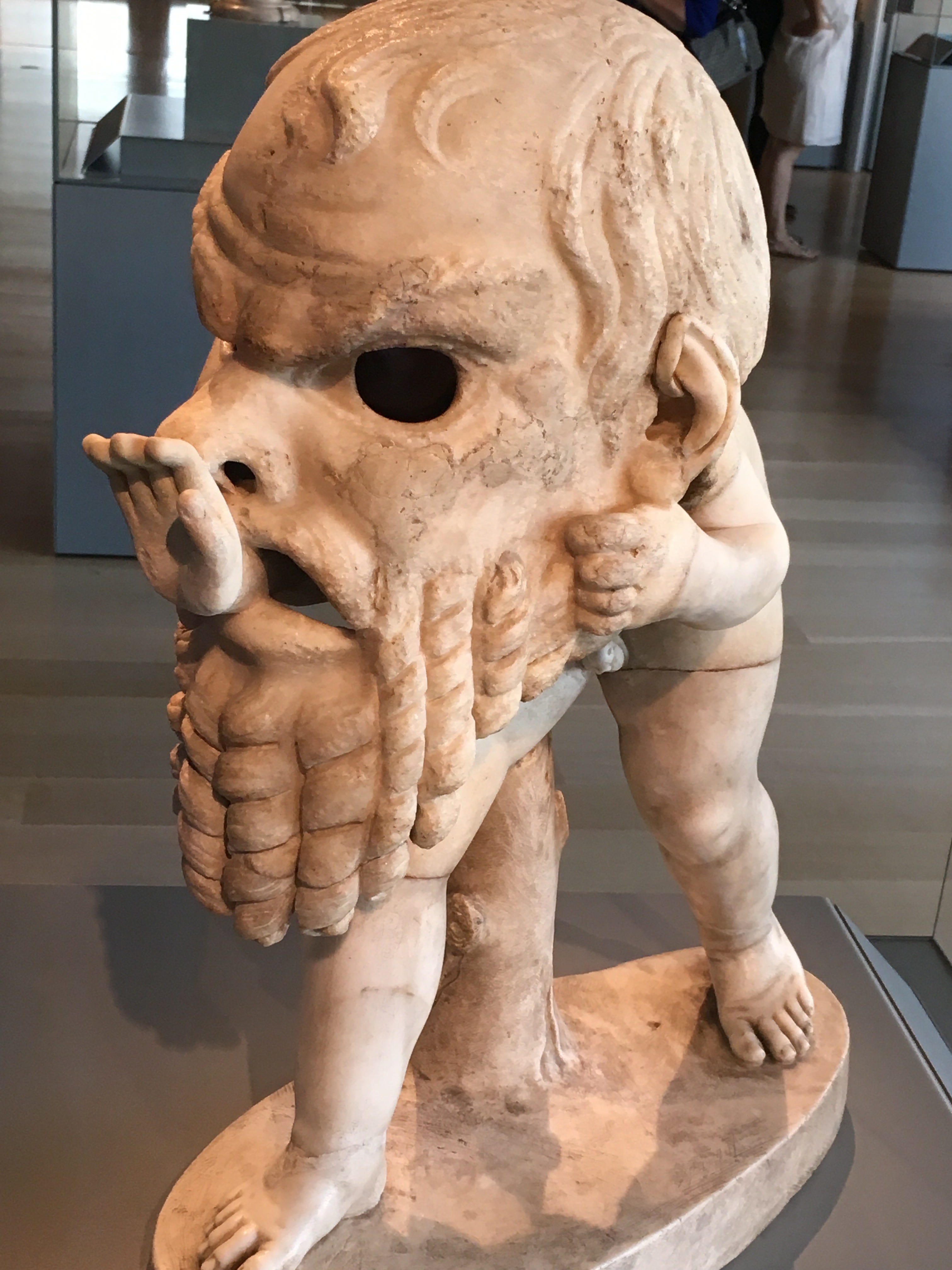
Another mask, neither comedic nor tragic, but of stifling self-doubt (sculpture in The Chicago Art Institute)
I’ve read enough artists’s and writers’s journals to know that we’ve all been infected by the disease. It suggests another flip-side metaphor, in which the blackness of doubt is manifested by the whiteness of the blank page—the page, or canvas, on which we cannot make a first mark.
The diagnosis, below, is a small part of my soi-disant How to Write a Great Book:
Writer’s Block
Let’s face it. Not everyone can be a Balzac or Proust—writers who never experienced terror when facing the mind-numbing blankness of the page. On the contrary, whole reams of paper had nightmares about them. For the rest of us, we know that somewhere, someday, we’ll face that horrid whiteness and not a single word will form on our fingertips. Worse, fear begets fear, and that dread can become a self-fulfilling prophecy.
Was Melville’s famous chapter on the whiteness of the whale really about the horrors of the blank page? Walker Percy, a century later, was filled with the same dread: “...I’m looking at this stupid piece of paper and wondering what’s going to happen, what am I doing here. This is a bad way to spend your life.”
It can’t be a coincidence that two very different writers have described their writing process in oddly similar ways. Sportswriter Red Barber explained, “There’s nothing to writing. All you do is sit down at a typewriter and open a vein.” Screenwriter Gene Fowler didn’t think that minor self-surgery was required: “All you do is sit staring at a blank sheet of paper until drops of blood form on your forehead.” The association of typewriters and blood is not that far-fetched; Sinclair Lewis typed five thousand words a day—with just his band-aid-tipped index fingers.
Writer’s block is a self-inflicted [I originally typed “self-inflected”] wound. While Flannery O’Connor was still in college, she wrote in her journal: “I must do do do and yet there is the brick wall that I must kick over stone by stone. It is I who have built the wall and I who must tear it down.”
Paid subscribers to these Substack pages get access to complete editions of two of my novellas. Noirvella is a modern story of revenge, told in the style of film noir. Unbelievable is a kind of rom-com that forms around a pompous guy who is conceited, misinformed, and undeservedly successful. Both books are sold by Amazon, but paid subscribers can read them for free. Also, Substack pages (older than eight months) automatically slip behind a paywall—where only paid subscribers can read them. If you’re interested in reading any of them, you can subscribe (giving you free access to them) or buy them in book form, should you prefer the feel of a physical book. Meanwhile, it is easy to become a paying subscriber (just like supporting your favorite NPR station). It’s entirely optional, and—even if you choose not to do so—you’ll still get my regular Substack posts—and I’ll still be happy to have you as a reader.