Two Pies Are...

…not, as you might suppose, the circumference of a circle (or even two circles—‘though every Thanksgiving and Christmas dinner ended the same way when I was young): with two circular pies. One Pumpkin and one Mince. Today, whenever I’m called upon to bake desserts for holiday meals, at least one of them is likely to be mince. I do this despite the fact that only two people look forward to mince pie: me and my mother-in-law. That’s good for both of us, because we take home the leftovers.
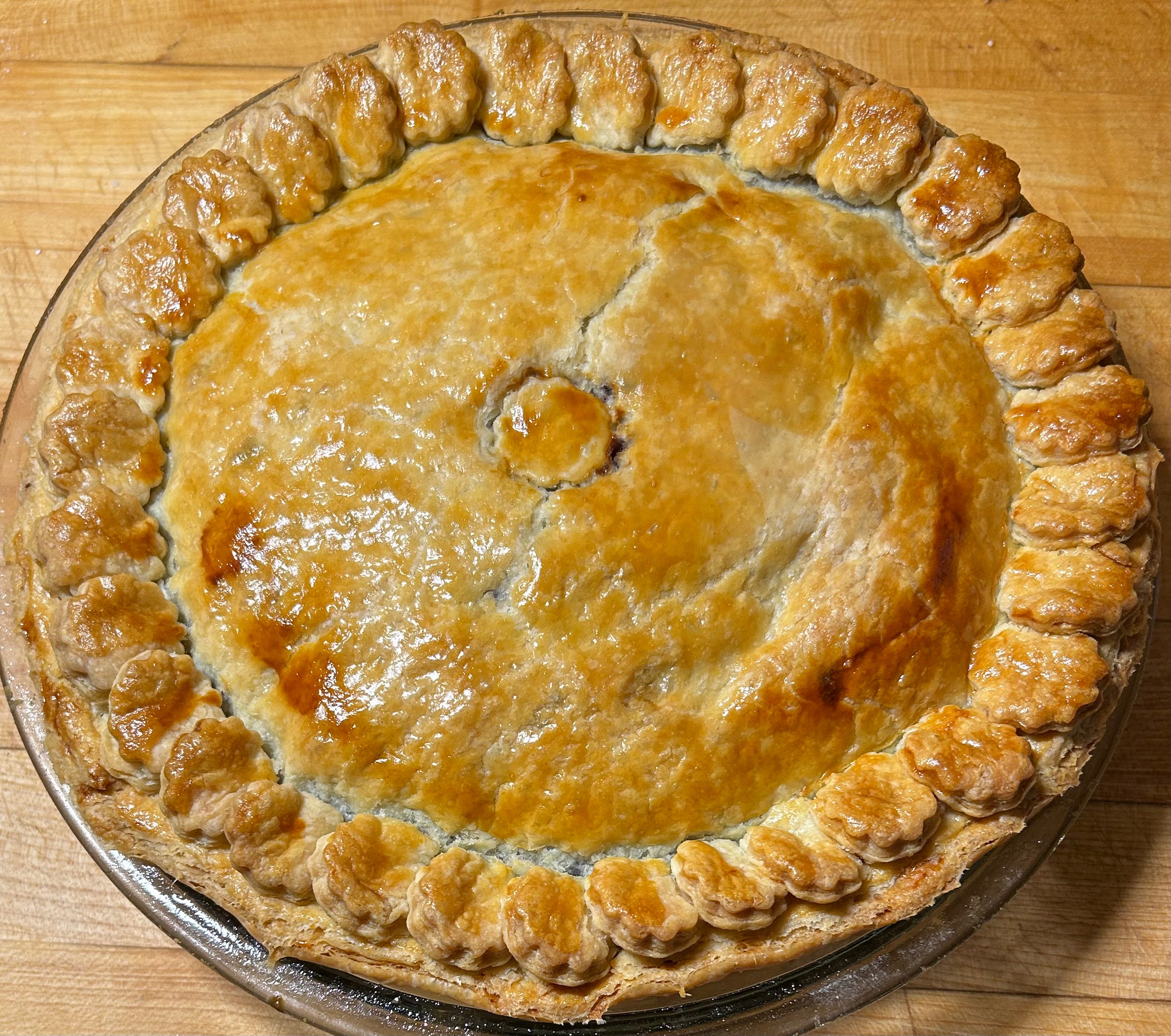
As an adolescent, I could never choose between the two pies, so my practice was to have a largish slice of each. The mince, à la mode (with vanilla ice cream); the pumpkin, topped with whipped cream. Some might say that was gilding the lily—but they would be wrong on two counts:
First, too much of a good thing is never too much (as Jerry Garcia, explained, “too much of a good thing is just about right”).
Second, the expression “gilding the lily” is flat wrong. The actual quote from Shakespeare’s King John was:
To gild refined gold, to paint the lily,
To throw a perfume on the violet,
To smooth the ice, or add another hue
Unto the rainbow, or with taper-light
To seek the beauteous eye of heaven to garnish,
Is wasteful and ridiculous excess.
Why even discuss this after-the-holiday pie, and a misquoted play from the sixteenth century? Obviously, I like mince pie (especially to “ridiculous excess”). That’s true, even though I usually have to explain what it is—mostly to people who have never tried it, but are dead certain that they don’t like it.
Most of those people are put off by the word “mincemeat.” They don’t know what it means, but it sounds ominous to them. I don’t know how many times I’ve had to explain what mincemeat once was, and is no longer, to people who will probably never risk even a taste of a dessert they dread. I won’t trouble you with my explanations because I’ve heard myself do it too often, and because someone else has done the job for me.
My other motivation is simple curiosity about Shakespearean misquotations. Has anyone ever collected all of the mangled versions of The Bard’s words? I’ve got Shakespeare’s Bawdy, but haven’s seen anything like Shakespeare Abused. Maybe I have to collect expressions like “all that glitters is not gold…” which, in The Merchant of Venice, was “All that glisters is not gold.” Or, near the end of The Maltese Falcon, with Bogart describing the MacGuffin as “the stuff that dreams are made of.”
The actual quote is “We are such stuff as dreams are made on,” from Shakespeare’s The Tempest. For me, two slices with two toppings are truly “such stuff as dreams are made on.”
While I have accumulated more years than Mark Twain managed in his lifetime, I’m not so old that I need to say, as he did, “I stopped frolicking with mince-pie after midnight; up to then I had always believed it wasn’t loaded.”
Paid subscribers to these Substack pages get access to complete editions of two of my novellas. Noirvella is a modern story of revenge, told in the style of film noir. Unbelievable began as a rom-com that formed around a pompous guy who is conceited, misinformed, and undeservedly successful (it has since continued to grow as new stories about its anti-hero emerge). Both books are sold by Amazon, but paid subscribers get to read them for free. Also, substack pages (older than eight months) automatically slip behind a paywall—where only paid subscribers can read them. If you’re interested in reading any of them, you can subscribe (giving you free access to them), or buy them in book form should you prefer the feel of a physical book. Meanwhile, it is easy to become a paying subscriber (just like supporting your favorite NPR or PBS station). It’s entirely optional, and—even if you choose not to pay—you’ll still get my regular substack posts—I’m always happy to have free subscribers as readers.
You had me at two pies. And there is no such thing as too much of a goof thing when it comes to pie.